CRI Comments on Natural Logic’s White Paper on EPR for Packaging
March 2011 | Natural Logic recently produced a white paper for the Coca Cola Company that summarizes an industry policy agenda for the next generation of packaging waste management stressing the principle of extended producer responsibility or “EPR.” CRI examines the paper and analyzes some flaws in its approach.
Recycling and Climate Change
CRI submitted this briefing in particular to protect the Iowa deposit law from repeal. It also serves to enhance the level of understanding of beverage container recycling in the United States and the State Iowa, and to demonstrate the impact of recycling on emissions reduction and the economy.
Why Universal Recycling in Vermont Requires Deposit Return
February 2011 Written to bolster the argument against repealing the Vermont deposit law, this briefing explains the benefits of deposit laws and the added benefits of deposit laws in conjunction with curbside recycling.
CRI’s review of Maine DEP’s February 2015 report, “Implementation of Product Stewardship in Maine” (January 20th, 2015)
Container Recycling Institute (CRI) would like to commend the Department on preparing a thoughtful comprehensive report. Maine’s impressive, and growing, list of EPR programs is a tribute to your ongoing commitment to product stewardship and responsible materials management.
CRI’s letter concerning Vermont H. 104 (March 11th, 2015)
CRI provides information related to Vermont H. 104. In particular, we’d like to correct some misstatements that were made in testimony.
CRI’s letter concerning CalRecycle’s Quarterly Report on the Status of the Beverage Container Recycling Fund (July 24th, 2014)
The Container Recycling Institute has comments and questions for the Department to help clarify understanding of the Fund’s finances. Download PDF [PDF, 138KB]
Comments on Draft to Report to Minnesota Pollution Control Agency (MPCA) Recycling Refund System Cost Benefit Analysis (January 22, 2014)
The Container Recycling Institute is pleased to submit our comments on the draft report Recycling Refund System Cost Benefit Analysis, prepared by ReclaySteward Edge (RSE). Download PDF [PDF, 324KB]
Support for MA Bill H.3848/Updating Massachusetts’s Beverage Container Recycling Bill (March 6, 2014)
The Container Recycling Institute writes to urge support for of Bill H.3848 to update Massachusetts’ Beverage Container Recycling Bill Download PDF [PDF, 385KB]
CRI Summary of CalRecycle’s Budget Change Proposal “Increase Beverage Container Recycling Revenue through Increased Audit Coverage”
First of three proposals, First Quarter 2014
CRI Summary of CalRecycle’s Budget Change Proposal “Beverage Container Recycling Program Reform Phase II: Sustainably Reducing the Structural Operating Deficit”
Second of three proposals, First Quarter 2014
CRI Summary of CalRecycle’s Budget Change Proposal “Initial Transition for Support of DORIIS from Contractor to State Staffing”
Third of three proposals, First Quarter 2014
Maine DEP’s February 2014 report, “Implementation of Product Stewardship in Maine”
The Container Recycling Institute (CRI) would like to commend the Department on preparing a thoughtful and comprehensive report. Maine’s impressive, and growing, list of EPR programs is a tribute to your ongoing commitment to product stewardship and responsible materials management. Download PDF [PDF, 90KB]
Vermont S.208 – testimony in opposition to portions of S. 208 (partial repeal of container deposit program)
CRI expresses our opposition to certain portions of Vermont S. 208, specifically those provisions which would repeal Vermont’s container deposit on liquor containers and all beverage containers greater than one liter in size.
CRI letter to CalRecycle regarding MRF performance standards
CRI’s 8/1/13 letter on the method used for the evaluation of recyclables and residuals at Mixed Waste Processing Facilities (MWPF) seeking certification as well as source-separated facilities.
CRI Comment Letter to Vermont Agency of Natural Resources
CRI’s 8/30/13 letter regarding ANR’s Draft Report Systems Analysis of the Impact of Act 148 on Solid Waste Management in Vermont
CRI Letter to State of Vermont Department of Environmental Conservation
March 2013 | CRI Commends Agency’s Report: Comparison of System Costs and Materials Recovery Rates: Implementation of Universal Single Stream Recycling With and Without Beverage Container Deposits
CRI Letter to Hawaii Legislature in Support of of SB 1133/HB 902
March 2013 | A Letter from CRI President Susan Collins to Hawaii Legislators in support of SB 1133 and HB 902 which would expand the state’s existing beverage container recycling program to include dietary supplements, including energy drinks, such as Monster and Red Bull.
CRI Letter to Hawaii Legislature in Support of HB 1062/SB 1271
March 2013 | A Letter from CRI President Susan Collins to Hawaii Legislators in support of HB 1062 and SB 1271 expanding the state’s beverage container recycling program.
A Clean and Green Vermont 2013
February 2013 | A Special Report on the Environmental and Economic Benefits of Vermont’s Bottle Bill Get
Implementing Product Stewardship in Maine 2013
January 2013 | CRI’s Review of Department’s Report to the Joint Standing Committee on Environment and Natural Resources: Implementing Product Stewardship in Maine.
Curbside vs Beverage Fact Sheet 2012
July 2012 | Curbside Recycling Access Rates and Beverage Container Recycling
CRI Letter to US EPA on the Municipal Solid Waste Report
September 2011 | The US EPA recently invited the public to comment on its annual Municipal Solid Waste report. CRI submitted a number of suggestions, including several regarding the accounting for contamination in calculating recycling rates.
CRI Comments on “The Costs of Beverage Container Redemption in Vermont”
April 2011 | A Report by DSM Environmental Services, Inc.for the Vermont Agency of Natural Resources Solid Waste Program
Coalition Sign-On Statement in Support of Modernizing Connecticut’s Bottle Bill – February 1st, 2020
We, the undersigned, are united in our strong support for expanding and modernizing Connecticut’s Container Deposit Law (AKA the Bottle Bill) as a means of increasing recycling in Connecticut, saving municipalities money, addressing the solid waste & recycling crisis, the climate emergency and protecting our environment. Important steps Connecticut can take to create a working, […]
CRI Testimony on MA H2837: “An Act to increase recycling in the Commonwealth:” Support if Amended & S1939: “An Act to increase container recycling in the Commonwealth:” Support if Amended – January 21st, 2020
The Container Recycling Institute (CRI) would like to register its support—if amended—of H2837 and S1939, similar bills that would conditionally expand, or update, the beverage container deposit law (or “bottle bill”) to include many non-carbonated beverages.
CRI Letter on California SB372 – January 14th, 2020
We are writing in with neither support nor opposition of SB 372, which would transition the State’s existing Beverage Container Recycling and Litter Reduction Act from a state government-run program (managed by CalRecycle) to an Extended Producer Responsibility program, managed by the beverage distributors through a Beverage Container Stewardship Organization (BCSO).
CRI supports RFR – Processing Payment Emergency Regulations – December 10th, 2019
The Container Recycling Institute (CRI) supports the 10% reasonable financial return (RFR) as proposed in the Processing Payment Emergency Regulations (CCR Section 2975, Subchap. 12, Chapter 5, Division 2 of Title 14).
CRI Support Letter for Colorado Beverage Redemption Program – October 21st, 2019
We are writing in support of the proposed beverage container deposit law now before the Zero Waste and Recycling Interim Study Committee.
CRI Supports Modifying CCR §2200(b) – October 18th, 2019
We are writing to state our support for modifying CCR §2200(b) to allow aluminum beverage can manufacturers to mark cans on either the top or the side of aluminum cans with CRV redemption information.
Reasonable Financial Return for recycling centers – August 23, 2019
In December 2018, CRI submitted a letter to CalRecycle in favor of emergency regulations changing the RFR used to calculate 2019 processing payments (attached). We wrote that the proposed RFRs of 11% and 16% for rural sites were “nowhere near enough to avert the impending financial crisis for redemption centers.”
CRI supports AB 792 – April 23rd, 2019
We are writing in support of AB 792, which would require plastic beverage bottle manufacturers to make their bottles out of 100% recycled content by 2035, with intermediate goals to be reached incrementally.
CRI Supports AB 815 – March 28th, 2019
We are writing in support of dual-stream recycling, in relation to AB 815, “Integrated waste management plans: source reduction and recycling element: dual stream recycling programs.”
CRI Supports CT HB7294 – March 11th, 2019
The Container Recycling Institute (CRI) conceptually supports Bill HB 7294, with suggestions for amendments. HB 7294 would update Connecticut’s beverage container deposit law, or “bottle bill,” in several ways.
CRI supports NYS2828 – February 11th, 2019
We are writing in support of S2828 “An Act to amend the environmental conservation law, in relation to the requirements for lead agency.” This bill would place a deposit on hard cider.
CRI’s Opposition to House Bill 1795 – February 6, 2019
We write to offer our opposition to HB 1795, “Ensuring the long-term economic and environmental sustainability of the state’s recycling system within the existing regulatory structure.”
CRI opposes repeal of the Michigan’s Beverage Container Deposit Law – December 4th, 2018
The Container Recycling Institute opposes the following bills before the Michigan House of Representatives: HB 6532, 6533, 6534, 6535, and 6536. Together, these bills would collectively repeal the state’s beverage container deposit law, or bottle bill.
CRI letter to CalRecycle in support of extending emergency regulations to boost payments to redemption centers, 12-10-18
The Container Recycling Institute supports the adoption of emergency regulations changing the reasonable financial return (RFR) applied to the calculation of processing payments for the period of January 1, 2019 to December 31, 2019.
Guidance on Eligibility to Qualify for the Retailer Exemption from Beverage Container Redemption under 10 V.S.A. § 1523b. October 12th, 2018
The retailer exemption requirements are changing because, in 2018, the Vermont Legislature passed a bill repealing Agency of Natural Resource’s Environmental Regulation § 10-105(d) which specified that “A retailer, with the prior approval of the Secretary, may refuse to redeem beverage containers if a certified redemption center operates within a five mile radius of the […]
CRI supports IA HF2155
“An Act relating to the applicability of beverage containers control provisions and the handling fees pursuant to those provisions.” This bill seeks to update the Iowa deposit law to include almost all non-carbonated beverage containers, and to raise the handling fee from the current one cent to two cents per redeemed container.
CRI supports CT SB10
The Container Recycling Institute (CRI) supports Sections 27 and 28 of Governor’s Bill SB 10. Section 27 would update Connecticut’s beverage container deposit law, or “bottle bill,” by placing a 5-cent deposit on most non-carbonated beverages, and on wine and liquor; Section 28 would set the deposit on wine and liquor at 25¢.
CRI Supports CT Handling Fee HB 5457
The Container Recycling Institute supports Raised Bill No. 5457, “An Act Concerning Bottle Redemption Centers.” This bill seeks to update the Connecticut deposit system by raising the handling fee from the current 1.5¢ on beer and 2¢ on carbonated soft drinks and water to 3.5¢ on all deposit beverages.
The Container Recycling Institute supports House Bill 5486 – February 16th, 2018 (Michigan)
The Container Recycling Institute supports House Bill 5486, which would update the Michigan deposit law to include almost all non-carbonated beverage containers.
Task Force recommendations to the CT General Assembly on the CT Container Deposit Law – January 19, 2018
On behalf of the undersigned organizations, we are writing to express our collective concerns related to draft recommendations from the Task Force to Study Methods for reducing Consumer Packaging (hereafter referred to as the “Task Force”), which deal with Connecticut’s Container Deposit Law (AKA the “CT Bottle Bill”).
LD 1703 “An Act To Create Equity for Wine and Spirits Container Deposits” – OPPOSE – January 2018
While we agree that the current deposit policy in Maine can be reformed for the better, this proposed legislation is not the answer. Maine, with an impressive redemption rate of 90%, is a leader in recycling – this bill would chip away at that success.
CRI Response to Emergency Increase in Processing Payment – October 13th, 2017
The Container Recycling Institute supports the proposed changes to the Reasonable Financial Return (RFR) described during the Workshop on Processing Payment Emergency Rulemaking. Based on our analyses that I will detail below, we believe this a good solution to the current problem.
CRI supports H3528: An Act promoting the proper disposal of miniatures – June 2, 2017
The Container Recycling Institute supports H3528 (Rep. Hunt, R-Sandwich), which would add miniature bottles of 100 milliliters or less (known as “nips”) to the Commonwealth’s beverage container deposit law, or “bottle bill.” Nips are currently exempt from the 5¢ deposit.
CRI Supports Most Budget Committee Recommendations for CalRecycle (California) – June 1, 2017
The Container Recycling Institute (CRI) supports the Assembly budget committee recommendations for CalRecycle’s Beverage Container and Litter Reduction Act program. CRI supports the budget committee proposal for funding for “enhanced oversight, audit and enforcement in the beverage container recycling program.
CRI Opposes Connecticut Senate Bill 996 CRI Supports House Bill 5618 – April 10th, 2017 (Updated)
The Container Recycling Institute (CRI) supports HB 5618, which would increase the beverage container handling fee that is paid to redemption centers and retailers by one cent. CRI opposes Senate Bill 996, “An Act Establishing a Bottle Recycling Fee In Lieu of a Refundable Deposit.” It would repeal the existing beverage container deposit law (the […]
CRI Opposes S.1865 and H.1744 – February 2017
The Container Recycling Institute (CRI) opposes the Senate bill S.1865 (Sen. Moore), “An Act improving recycling in the Commonwealth,” and the identically-titled House bill H.1744 (Rep. Garry). These bills would repeal the existing beverage container deposit law (the “bottle bill”), and in its place would impose a 1-cent fee on all carbonated and non-carbonated beverages, […]
Maine – CRI Opposses Maine LD 683
The Container Recycling Institute opposes LD 683, entitled, “An Act To Fund the Maine Solid Waste Diversion Grant Program and to Phase Out Certain Containers from the Bottle Redemption Laws.”
Winners and Losers: A Financial Analysis of Iowa’s HSB 163
A repeal of Iowa’s Bottle Bill with a new penny fee on carbonated beverages, wine, and spirits.
New Excise Tax in HSB 163 Would Only Fund Cleanup of 13% of the New Beverage Container Litter Created by Repealing the Bottle Bill
Iowa’s 5¢ deposit on beer, soft drinks, wine, and spirits is an effective incentive to refrain from littering bottles and cans or to pick up and redeem containers littered by others.
Testimony of the Container Recycling Institute on “Smart Container Act” for the Environment and Solid Waste Committee (April 1st, 2016)
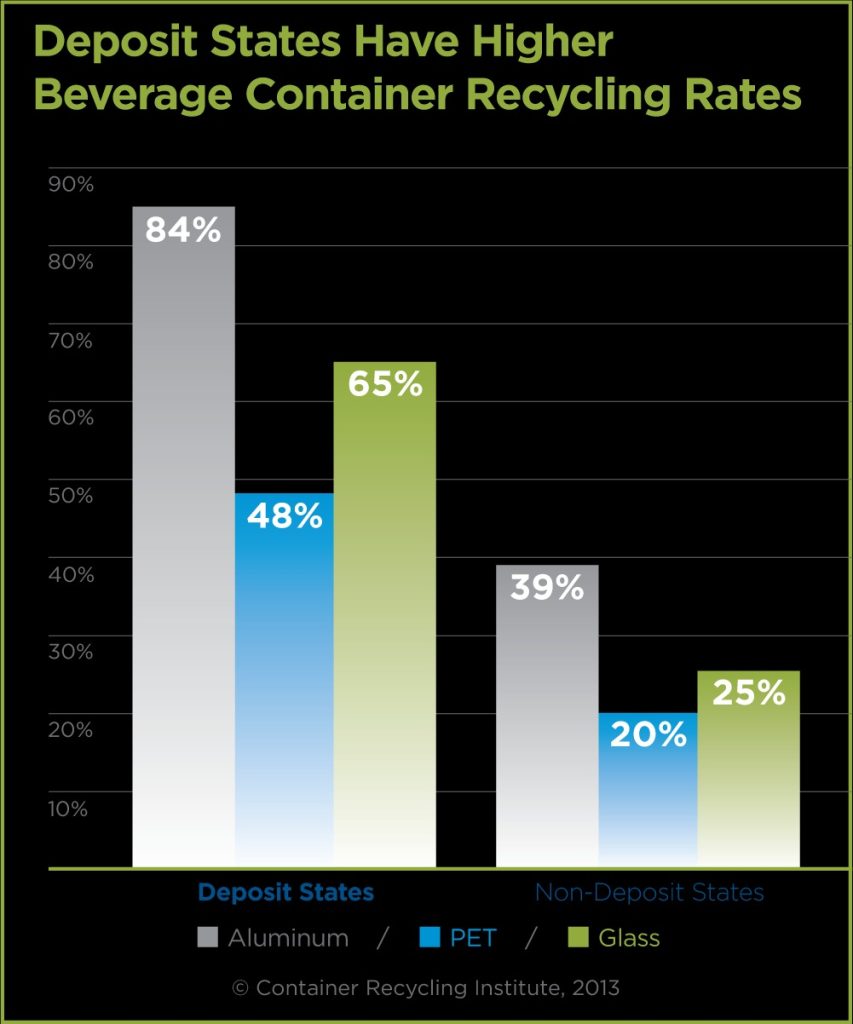
Refundable deposits have been shown to be an efficient and effective way to significantly increase recycling rates of beverage containers. In the 10 states that have refundable deposits, the beverage Figure 1: Deposit States Have Higher container redemption rates average 84%.
Testimony supporting Connecticut Senate Bill 384 (March 10th, 2016)
The Container Recycling Institute (CRI) supports SB384, “An Act Concerning the Application of the Bottle Bill to Wine and Liquor Bottles for Purposes of Funding State Parks.” SB384 would update Connecticut’s existing beverage container deposit law, or “bottle bill,” to include wine, sparkling wine and champagne, and liquor (spirits).
Testimony opposing Connecticut Senate Bill 312 (March 9th, 2016)
The Container Recycling Institute (CRI) opposes SB312, “An Act Requiring The Department Of Energy And Environmental Protection To Study Bottle Bill Beverage Container Refund Values And Redemption Fees.” SB312 would study the repeal the existing beverage container deposit law (the “bottle bill”), and in its place would impose a 4-cent fee on all carbonated and […]
Testimony supporting Maryland House Bill 862 “Maryland Redeemable Beverage Container Recycling Refund and Litter Reduction Act” (March 2nd, 2016) (March 2nd, 2016)
Container deposit programs relieve municipalities of the operational burdens and financial costs of collecting beverage containers. Lost revenue from material that is currently collected in municipal recycling programs is relatively insignificant when compared to the avoided collection and disposal costs, as well as litter cleanup and storm drain cleanout costs.
CRI and others Oppose MA House Bill 646 (February 23rd, 2016)
As experts in environmental protection, public health, conservation, water quality and waste reduction, we are unanimous in our opposition to House Bill 646, entitled the “Universal Recycling Law.” While that title sounds appealing, the bill does three things, all of which we reject.
H2875: “An Act to increase recycling in the Commonwealth:” Support if Amended S1752: “An Act to increase container recycling in the Commonwealth:” Support if Amended (December 2nd, 2015)
The Container Recycling Institute (CRI) would like to register its support—if amended— of H2875 and S1752, similar bills that would conditionally expand, or update, the beverage container deposit law (or “bottle bill”) to include many non-carbonated beverages.
Testimony supporting Massachusetts H2916, “An Act to expand the bottle bill” (November 12th, 2015)
The Container Recycling Institute supports H2916, which would would add water bottles to the definition of beverage containers under the Commonwealth’s highly-‐successful beverage container deposit law (“bottle bill”), and would restore funding to the Clean Environment Fund. We will comment on both issues in this letter.
Revised testimony regarding CRI’s opposition to H2880 and H646 – (October 31st, 2015)
The Container Recycling Institute (CRI) opposes H646, “An Act improving recycling in the Commonwealth,” and the identically-titled bill H2880.
Testimony of the Container Recycling Institute on “Recycler’s Perspective” for the Recycling Policy Study Committee – (October 19th, 2015)
CRI presents testimony to the Recycling Policy Study Committee concerning refundable deposits to have been shown to be an efficient and effective way to significantly increase recycling rates of beverage containers.
CRI’s letter concerning Vermont H. 104 – testimony regarding H. 104 (May 2015)
The Container Recycling Institutes letter providing further information related to Vermont H. 104. In particular, to answer clarifying questions asked by committee members about the relatively high cost to collect and process PET in recycling programs as well as the documentation of cost savings to municipalities after implementation of beverage container deposit programs.
LD 1204, “An Act To Increase Recycling and Composting by Creating the Maine Recycling Fund ” – OPPOSE; Financial Analysis LD 1204 (April 23rd, 2015)
The Container Recycling Institute opposes LD 1204, entitled, “An Act To Increase Recycling and Composting by Creating the Maine Recycling Fund.” By reducing the scope of the State’s beverage container deposit law, LD 1204 would be a step backwards for recycling.
CRI Supports HB 1652 – New Hampshire January 17th, 2022
We are writing in support of House Bill 1652, “An Act Relative to the Recycling of Beverage Containers.” This bill would establish a beverage container deposit law in New Hampshire, effective 1/1/23.
CRI supports CalRecycle’s proposal to extend the Processing Payment Emergency Regulations – December 16th, 2021
The Container Recycling Institute supports CalRecycle’s proposal to extend the Processing Payment Emergency Regulations for one year. The Emergency Regulations employ a 10% RFR (reasonable financial return) to calculate the processing payments that will be made to certified recyclers for 2021, in order to offset the difference between their operating costs and the revenues they […]
CRI supports H.3284 “An Act relative to containers, litter, ecology and nips (CLEAN Act)” (Massachussets) – September 14th, 2021
This bill would add alcoholic beverages of up to 100ml to the MA beverage container deposit law. Effectively, this means spirits sold in miniatures, or nips: the tiny bottles that are ubiquitous as litter strewn across the Commonwealth’s roads and streets, beaches, parks, fields, and other places.
CRI supports H.3289 – Massachusetts – September 13th, 2021
As you may know, the Container Recycling Institute (CRI) is a national nonprofit organization and an authority on the economic and environmental impacts of container recycling. We are writing to state our support of H.3289, “An Act to Expand the Bottle Bill” (Decker), and its companion bill S.2149 (Creem).
CRI supports H.3277 and respectfully suggests a few amendments. – Massachusetts – September 13th, 2021
We are writing to state that we support H.3277 and respectfully suggest a few amendments. This bill will set the following postconsumer recycled content (PCR) goals for plastic beverage bottles covered under the container deposit law…
CRI supports S.2215, “An Act to Create a Deposit for Glass Wine and Liquor Bottles (Massachusetts) – September 13th, 2021
We are writing to state our support of S.2215, “An Act to Create a Deposit for Glass Wine and Liquor Bottles (O’Connor). This short bill packs a big punch in addressing a serious problem in Massachusetts: finding a home for hundreds of thousands of tons of discarded glass bottles.
CRI supports H3332 (Massachussets) – September 13th, 2021
As you may know, the Container Recycling Institute (CRI) is a national nonprofit organization and an authority on the economic and environmental impacts of container recycling. We are writing in support of H.3332 “An Act promoting the proper disposal of miniatures (Lewis/Hawkins).
CRI opposes AB 1454, changes to The California Beverage Container Recycling and Litter Reduction Act – June 25th, 2021
We are writing to state that our position on AB 1454, which makes changes to “The California Beverage Container Recycling and Litter Reduction Act,” is opposed unless amended
CRI opposes S.568 (Massachussets) – Resolve providing for an investigation and study of enhancing statewide recycling programs – June 22nd, 2021
We are writing in opposition to the part of the resolve that suggests studying repeal of the container deposit law. The effectiveness of container deposit laws has been studied many times, both within and outside of the United States.
CRI supports California’s AB 962 – June 21st, 2021
We are writing to state our wholehearted support for the reusable beverage container bill AB 962: “An act to amend Section 14539 of, and to add Sections 14525.1 and 14576 to, the Public Resources Code, relating to solid waste.”
CRI Supports H 996 An Act to improve plastic bottles and their recycling – Massachussets – June 21st 2021
We are writing in support of H 996, which would require plastic beverage manufacturers to make their bottles out of 25% recycled content by 2024, with intermediate goals to be reached incrementally.
CRI Supports California AB 962 Reusable Beverage Containers – April 12th, 2021
We are writing to state our wholehearted support for the reusable beverage container bill AB 962: “An act to amend Section 14539 of, and to add Sections 14525.1 and 14576 to, the Public Resources Code, relating to solid waste.”
CRI opposes Iowa HF 814 – April 20th, 2021
We are writing to state our opposition to HF 814 because it would diminish consumers’ access to redemption opportunities.
CRI Supports Connecticut Senate Bill 1037 – March 18th, 2021
We strongly support Senate Bill 1037, “An Act Concerning Solid Waste Management.” This bill modifies Connecticut’s beverage container deposit law (or “bottle bill’) in four stages.
Anticipated Revenue from Unclaimed Deposits Under a Modernized Bottle Bill (Vermont H.175) – March 11th, 2021
We are writing to shed further light on anticipated revenues from unclaimed deposits that would accrue to the State of Vermont upon passage of H.175: “An act relating to the beverage container redemption system.”
CRI supports Vermont H.175 – February 25th, 2021
We are writing in support of H.175, “An act relating to the beverage container redemption system,” which would update Vermont’s deposit law to include most non-carbonated beverage containers, and would raise the deposit to a dime.
CRI Comments on Methodology of the U.S. EPA in Calculating National Recycling Rates – March 8th, 2021
We are writing in regard to Docket ID No. EPA-HQ-OLEM-2020-0443 with comments about the methodology the U.S. EPA uses in calculating national recycling rates, and how this methodology might be improved. Among other things, we will discuss how a combination of overcounting recycling and undercounting generation artificially inflates the recycling rate.
CRI supports Maryland HB99 – February 5th, 2021
The bill would create a multi-stakeholder advisory commission charged with designing a framework for a beverage container deposit law in Maryland.
CRI supports AB793 July 3rd, 2020
We are writing in support of AB 793, which would require plastic beverage bottle manufacturers to make their bottles out of 50% recycled content by 2030, with intermediate goals to be reached incrementally.
CRI supports Maryland House Bill 824 – February 25th, 2020
We are writing in support of House Bill 824, “An Act Concerning Beverage Container Deposit Program – Establishment and Advisory Commission.”
CRI has serious concerns about the Governor’s 2023-2024 budget for the Beverage Container Recycling Fund – June 13th, 2023
CRI has serious concerns about the Governor’s 2023-2024 budget for the Beverage Container Recycling Fund (BCRF, 0133), including inaccuracies and the threat to the program from overspending and the proposal to loan out $140 million this year.
CRI supports SB 353 – California – June 5th, 2023
CRI strongly support SB 353 to amend The California Beverage Container Recycling and Litter Reduction Act, with some recommendations.
CRI Testimony In Opposition to LD 1910 “An Act to Amend the Returnable Beverage Container Program” – May 18, 2023
For more than 10 years, we have testified in support of modernization of Maine’s bottle bill. We have several concerns about LD 1910.
CRI Testimony to Vermont Senate Committee on H.158: An Act Relating to the Beverage Container Redemption System – May 4th, 2023
CRI President Susan Collins testifies at a hearing of the Vermont Senate Committee on Finance in support of proposed legislation to expand the state’s bottle bill to cover more types of beverages. Susan previously testified to another State Senate Committee and a State House of Representatives committee on the legislation, which the House passed on […]
CRI supports S237 – New York – May 1st, 2023
We strongly support S237 “An Act to amend the environmental conservation law, in relation to returnable bottles,” with some recommendations.
CRI supports SB 85 – Illinois – April 25th, 2023
We are writing today in opposition to raised bill 1236, “An Act Concerning the Amounts of Unclaimed Beverage Container Deposits to be Paid for Deposit in the General Fund.”
CRI opposes SB1236 – Connecticut – April 19th, 2023
We are writing today in opposition to raised bill 1236, “An Act Concerning the Amounts of Unclaimed Beverage Container Deposits to be Paid for Deposit in the General Fund.”
Additional CRI Testimony on Vermont’s H.158: An Act Relating to the Beverage Container Redemption System – April 12th, 2023
Following her testimony earlier this year at Vermont House of Representatives committee hearings in support of proposed legislation to expand the state’s bottle bill to cover more types of beverages, CRI President Susan Collins testifies in support of the bill at a hearing held by the Vermont Senate Committee on Natural Resources and Energy.
CRI Testimony on Vermont’s H.158: An Act Relating to the Beverage Container Redemption System – February 8th, 2023
CRI President Susan Collins testifies at a hearing of the Vermont House Committee on Environment and Energy in support of proposed legislation to expand the state’s bottle bill to cover more types of beverages.
CRI Testimony on Vermont’s H.158: An Act Relating to the Beverage Container Redemption System – January 19th, 2023
CRI President Susan Collins testifies at a hearing of the Vermont House Committee on Environment and Energy in support of proposed legislation to expand the state’s bottle bill to cover more types of beverages.
CRI Letter to California Office of Administrative Law on CalRecycle Processing Payment Emergency Regulations – October 26th, 2022
The Container Recycling Institute supports CalRecycle’s proposal to extend the Processing Payment Emergency Regulations for another year.
CRI supports SB 38 – California – September 8th, 2022
We write in support of your signature on SB 38 (Bob Wieckowski), which would require CalRecycle to study and develop a system or process to address the issue of glass contamination.
CRI neither opposes or supports SB 1013 – August 26th, 2022
The Container Recycling Institute is withdrawing our support for SB 1013, the bottle bill expansion to include wine and spirits containers. Our position is now neither support nor opposition.”
Letter from CRI to Assembly Committee on Appropriations Support for SB 1013 – July 25, 2022 (Updated)
We are writing in support of SB1013, “An act to amend Sections 14504 and 14550 of the Public Resources Code, relating to recycling, and making an appropriation therefor.”
Letter from CRI to California Assembly Committee on Natural Resources: Support for SB 38 – June 21, 2022
We write in support of SB 38, as amended June 20, 2022, which would correct an unintended wholesale exemption in California’s landmark postconsumer recycled plastic content law and make targeted improvements to the California Beverage Container Recycling and Litter Reduction Act of 1987 to address contamination and fraud
Flaw in California’s AB 793’s De Minimis Provision Threatens Operability of Entire Recycled Content Law – March 31st, 2022
Summary: There is a “de minimis” provision in California’s recycled content law that, combined with other provisions of the California’s beverage container deposit law (“bottle bill”) and recent scrap prices, could unintentionally exempt most beverage manufacturers from having to comply with the recycled content law; thus nearly negating the entire intent of the law.
CRI supports AB 2779 – California – March 31st, 2022
We are writing in support of AB 2779, “An act to amend Sections 14504 and 14560.5 of the Public Resources Code, relating to recycling, and making an appropriation…
CRI opposes SF2378, “An Act relating to the redemption of and payment of refund value on beverage containers, making appropriations, providing penalties, and including effective date provisions.” – March 24, 2022
This bill would remove retail stores’ (“dealers’”) obligations to refund consumers’ 5¢ beverage container deposits after July 1, 2023. In other words, consumers would no longer be able to conveniently turn in their beverage containers at one of the 2,000 retailers where they are sold.
Vermont Waste Disposal Increased from 2012 to 2017; Bottle Bill Materials Recycled at 87% Rate, Compared to 28% Rate for Other “Container” Materials – March 21, 2022
Review of Reported Recycling Rates Published in 2018 Vermont Waste Characterization Study
CRI supports HB 307 – “An act concerning Environment – Packaging Materials – Producer Responsibility” – Maryland – February 1st, 2022
We are writing in support of House Bill 307, “An act concerning Environment – Packaging Materials – Producer Responsibility,” on the condition that certain amendments are made, as outlined here.
CRI Provides Comment on CA SB 156 Handling Fee Regulations – December 9th, 2024
CRI appreciates the opportunity to comment on CalRecycle’s methodology in which a handling fee rate is defined, in alignment with SB 156.
CRI provides comment on CalRecycle SB1013 Dealer Cooperative Draft (15-Day Comment Period) – September 3rd, 2024
CRI appreciates another opportunity to provide comments on CalRecycle’s recent Draft Proposed Regulation Text regarding Dealer Cooperatives, as established by SB 1013. CRI also submitted a letter on the subject on September 28, 2023 and April 30, 2024.
CRI Opposes CA SB 551 – July 2, 2024
CRI opposes CA SB 551, which allows certain beverage manufacturers to submit consolidated recycled content reports with other beverage manufacturers, rather than individually.
CRI provides comment on Beverage Container Quality Infrastructure Grant (QIG) Program – June 21, 2024
CRI appreciates the opportunity to provide comments on CalRecycle’s $50 million Beverage Container QIG Program.
CRI Supports CA AB 457 – May 29, 2024
CRI supports CA AB 457, which would change the California refund value for boxes, bladders, pouches, and other similar containers containing wine or spirits from $0.25 to $0.10 (for < 24 fluid ounces) and $0.20 (for ≥ 24 fluid ounces).
CRI Supports CA AB 2511 – May 14, 2024
CRI supports CA AB 2511, which extends the inoperative date of the market development payment program to January 1, 2026. We also attached an addendum letter from 2023 outlining budget concerns for the BCRF.
CRI provides comment on CalRecycle SB1013 Dealer Cooperative Draft — April 30, 2024
CRI appreciates the opportunity to provide comments on CalRecycle’s recent Draft Proposed Regulation Text regarding Dealer Cooperatives, as established by SB 1013. CRI also attended the April 30th public hearing on the draft regulatory text.
CRI Supports MN SF 3887, Article 5, with Amendments – April 25, 2024
CRI supports, with amendments, MN SF 3887 Article 5, “Packaging Waste and Cost Reduction Act,” to establish an EPR for Packaging Program in Minnesota.
CRI Supports IL SB 85 – April 15, 2024
CRI supports IL SB 85 to establish Illinois’ beverage container recycling program
CRI Opposes CA SB 1113, Unless Amended – March 13, 2024
CRI opposes CA SB 1113 (unless amended), which extends the California Beverage Container Recycling and Litter Reduction Act’s pilot project programs to operate until January 1, 2034.
CRI Supports MI HB 5421 – March 11, 2024
CRI supports HB 5421, which would require dealers to have mandated hours of operation to provide convenient means of beverage container returns by consumers.
CRI Supports MD HB735 – February 26, 2024
CRI supports HB 735 to establish Maryland’s beverage container recycling program, with some recommendations.
CRI Supports MN HF3200 – February 20, 2024
CRI supports HF 3200 to establish Minnesota’s beverage container recycling program, with some recommendations.
CRI Testimony to Oregon House Committee on HB.4013 – February 14, 2024
This letter is a written response following CRI President Susan Collins’ testimony in Oregon’s House Committee on Climate, Energy, and Environment. Our position on this bill is neutral, but this testimony highlights the importance of including glass wine bottles in a deposit return system.
CRI Written Responses to U.S. Senate Subcommittee Questions on Solutions to Address Beverage Container Waste – October 26th, 2023
These responses are to questions asked by committee members, serving to better the understanding of deposit return systems in the United States.
CRI Testimony to U.S. Senate Subcommittee: “Examining Solutions to Address Beverage Container Waste” – September 28th, 2023
CRI President Susan Collins testifies to a subcommittee of the U.S. Senate Committee on Environment & Public Works on policies to improve the domestic collection of single-use beverage containers.
CRI provides comment on CalRecycle SB1013 Dealer Cooperative Draft – September 14th, 2023
The Container Recycling Institute (CRI) appreciates the opportunity to provide comments on CalRecycle’s recent Draft Proposed Regulation Text regarding Dealer Cooperatives, as established by SB 1013. CRI also attended the August 31st informal public workshop on the draft regulatory text.
CRI strongly recommends the EPA adopt the implementation of a DRS for Draft Strategy to Prevent Plastic Pollution. – July 31st, 2023
As part of the EPA’s commitments prescribed by the Save the Seas 2.0 Act, the Draft National Strategy to Prevent Plastic Pollution is a valuable opportunity for the government and various stakeholders to work together to address the growing plastic pollution problem.
CRI supports H.3690 & S.2104 (House Edition) – June 28th, 2023
We are writing to state our support of H.3690, “An Act to Expand the Bottle Bill” (Decker), and its companion bill S.2104 (Creem).
CRI supports H.3690 & S.2104 (Senate Edition) – June 28th, 2023
We are writing to state our support of H.3690, “An Act to Expand the Bottle Bill” (Decker), and its companion bill S.2104 (Creem).
US bottles and cans wasted in 2005
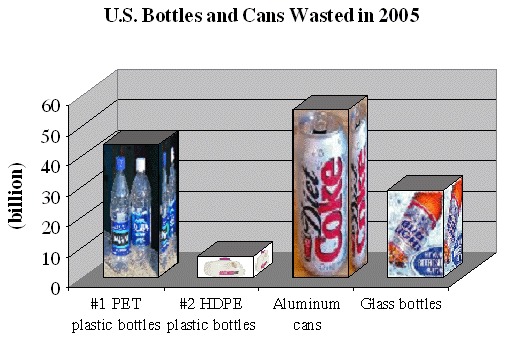
The Current Waste Situation The Current Waste Situation It is estimated that 134.1 billion beverage containers were not recycled in 2005–43.6 billion PET bottles, 6.8 HDPE bottles, 55.0 billion aluminum cans, and 28.8 billion glass bottles wasted. That’s an increase of nearly 4 billion from 2004’s total of 130.3 billion.
Percentage of population served by curbside vs. percentage of glass recycled
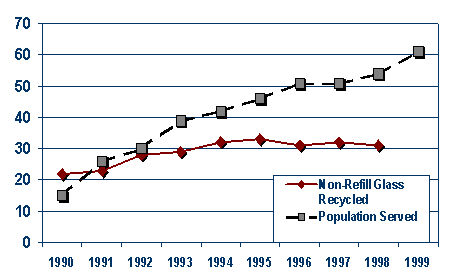
Source: The State of Garbage in America, Biocycle Non-Refillable GlassRecycling Rate U.S. Populationwith Access toCurbside Recycling 1990 22 % 15 % 1991 23 % 26 % 1992 28 % 30 % 1993 29 % 39 % 1994 32 % 42 % 1995 33 % 46 % 1996 31 % 51 % 1997 32 % […]
End-markets for collected glass
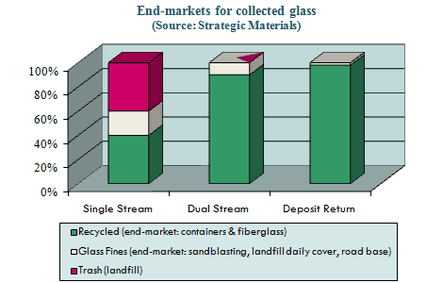
Different methods for collecting recyclable materials result in different degrees of quality in the collected materials. Research for the 2009 report on single-stream recycling showed that only 40% of glass from single-stream collection is recycled into containers and fiberglass. Forty percent of glass winds up in landfills, while 20% is small broken glass (“glass fines”) used for […]
Glass recycling rates
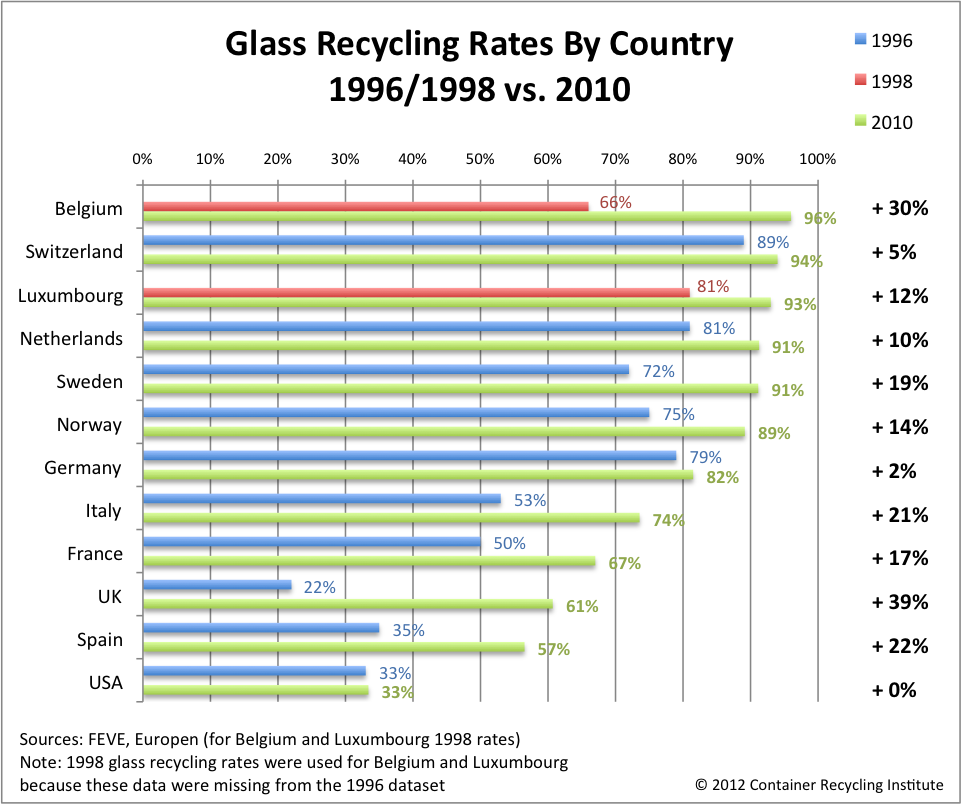
The recovery rate for glass containers has shown minimal growth between 1994 and 1997, increasing from 29 percent in 1994 to just 31 percent in 1997. But, because glass container production has declined, the number of tons of cullet (crushed glass) recycled actually dropped from 3.14 million tons in 1994 to 2.92 million tons in […]
US Plastic Bottled Water Sales
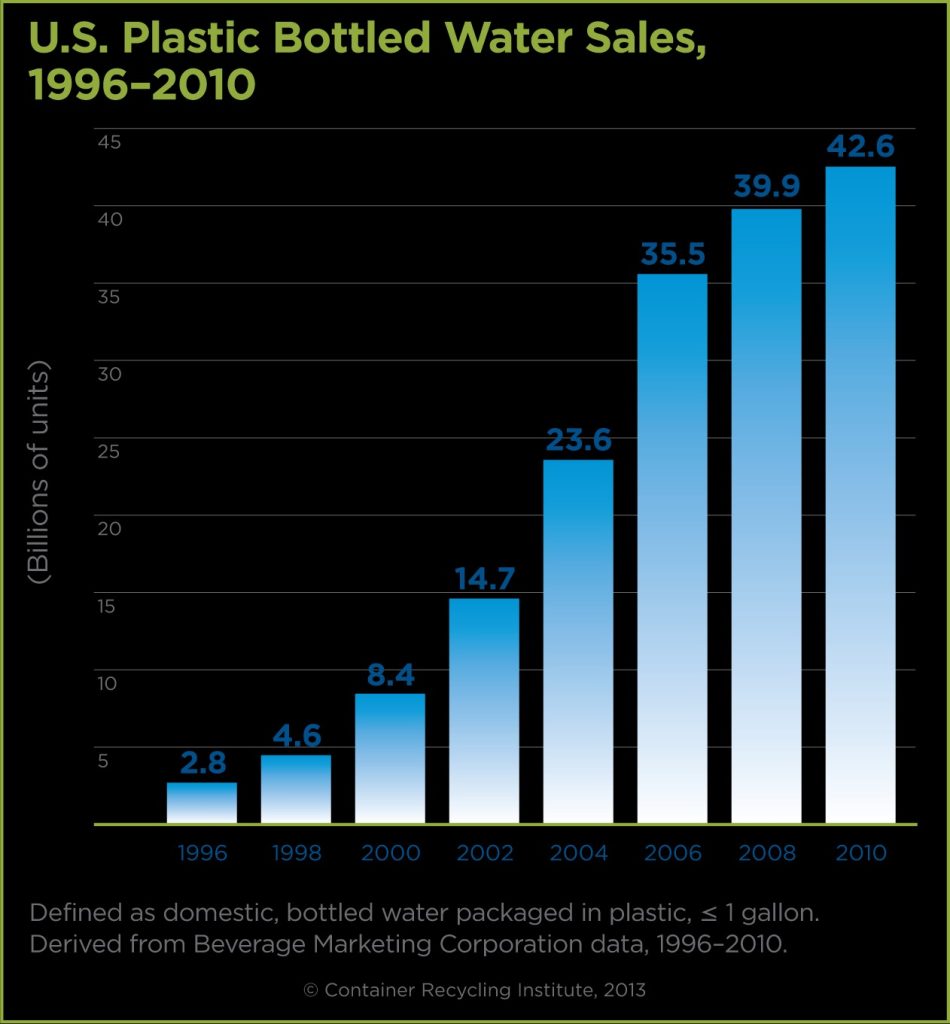
PET Recycling vs. Utilization Rates

Year Recycling Utilization 1995 39.7% 31.9% 1996 31.7% 26.0% 1997 27.1% 22.7% 1998 24.8% 19.6% 1999 23.7% 18.8% 2000 22.3% 18.0% 2001 22.1% 17.5% 2002 19.9% 15.3% 2003 19.6% 15.5% 2004 21.6% 17.3% 2005 23.1% 18.9% 2006 23.5% 19.4% 2007 24.6% 19.0% 2008 27.0% 20.9% 2009 28.0% 20.9% 2010 29.1% 20.8% 2011 29.3% 19.2% Source: […]
PET Sales, Wasting, and Recycling
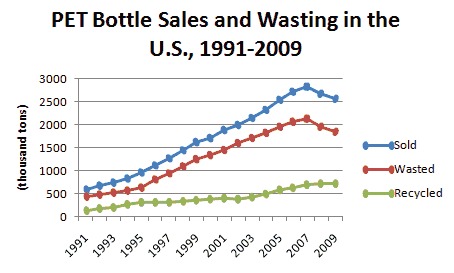
SOLD RECYCLED WASTED YEAR thousand tons thousand tons Recycling rate thousand tons 1991 609 152 24.9% 457 1992 694 201 29.0% 493 1993 757 224 29.6% 533 1994 857 273 31.9% 584 1995 973 322 33.1% 650 1996 1,138 316 27.8% 822 1997 1,276 325 25.4% 951 1998 1,453 355 24.4% 1,098 1999 1,625 370 […]
Estimated yield rates from collected plastic
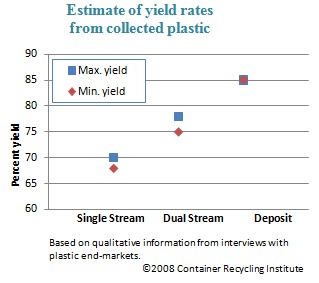
Plastics recyclers report that in general, material from single-stream MRFs has a yield rate of about 68%–70%, compared to dual-stream systems which usually yield about 75%-78%. Bales of PET from deposit return systems generally have a yield rate of about 85%. Chart from the 2009 report, Understanding economic and environmental impacts of single-stream collection systems
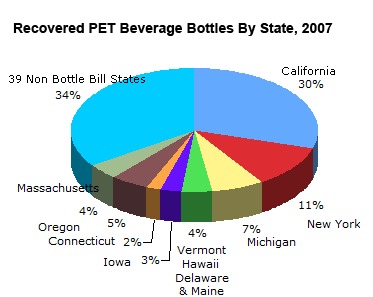
Recovered PET beverage bottles by state
HDPE bottle sales and wasting in the US
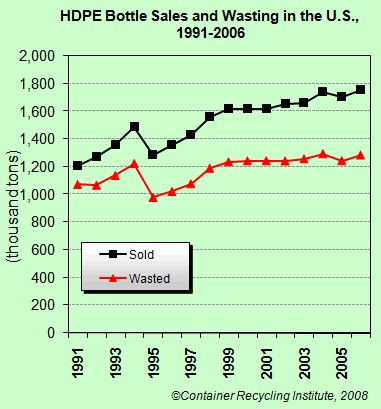
HDPE Bottle Sales and Wasting in the U.S., 1991-2006* YEAR SOLD thousand tons RECYCLED thousand tons Recycling rate WASTED thousand tons 1991 1,209 134 11.1% 1,075 1992 1,272 203 15.9% 1,069 1993 1,359 220 16.2% 1,139 1994 1,491 266 17.8% 1,225 1995 1,291 310 24.0% 980 1996 1,359 334 24.6% 1,025 1997 1,433 354 24.7% […]
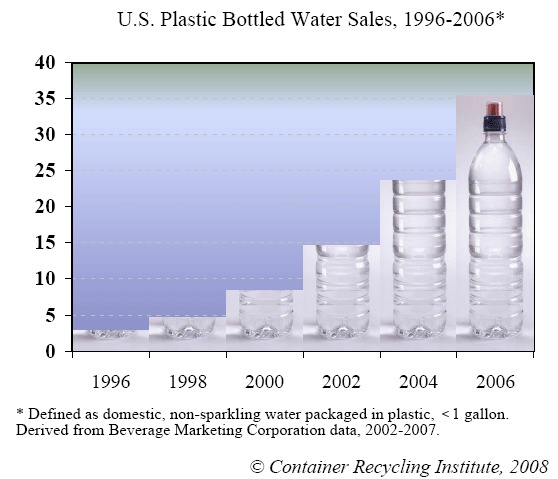
PET bottled water sales in the US

HDPE plastic beverage bottle recycling rates

PET plastic beverage bottle recycling rates

Recycling rates in Sweden and the US

Related graphs: Recycling Rate for Aluminum Cans in Sweden and U.S. (1984-2004) Side-by-side comparison of Sweden and U.S. recycling rates for both aluminum and plastic
PET bottle recycling and wasting: soft drink bottles vs. custom bottles
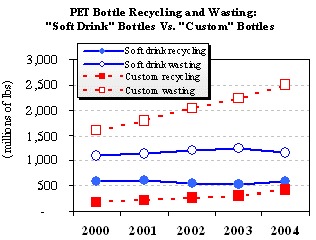
PET sales, recycling, and wasting: soft drink bottles
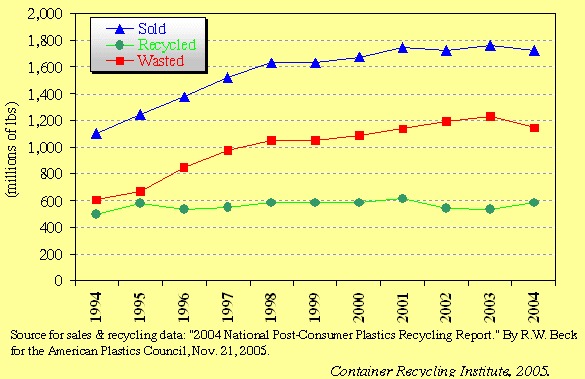
PET sales, recycling, and wasting: custom bottles
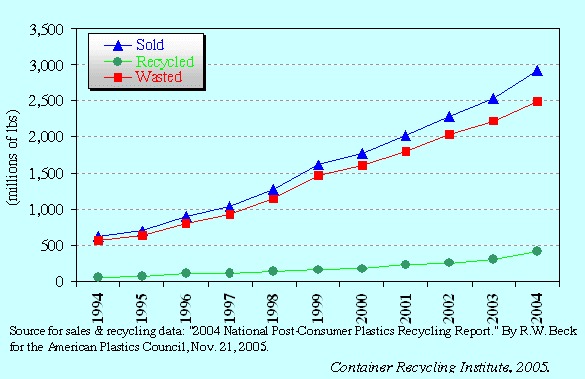
PET sales, recycling, and wasting: beverage bottles

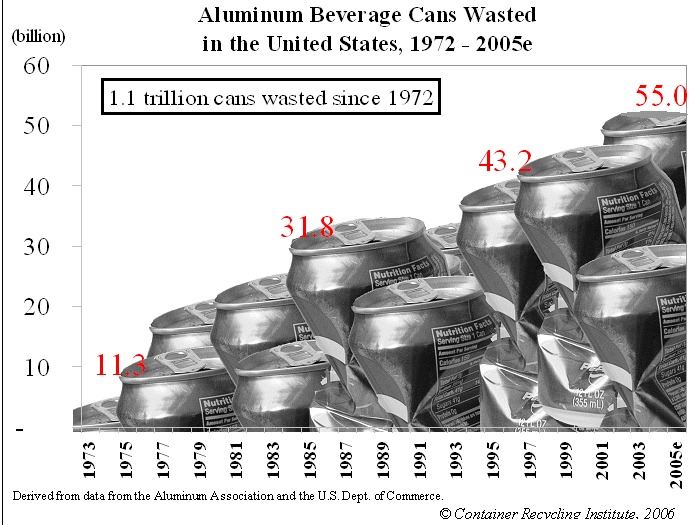
Plastic soda bottles wasted
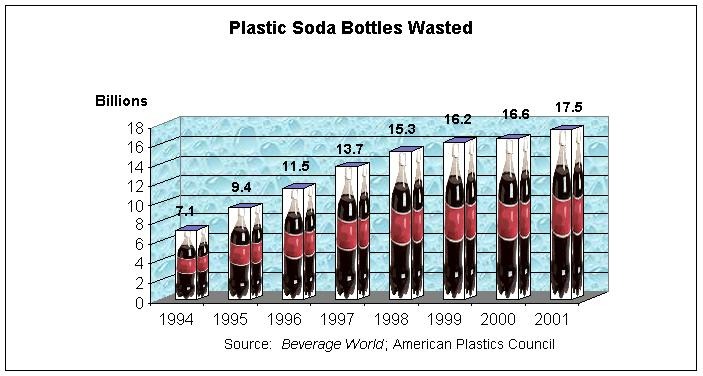
Wasted aluminum cans and PET bottles
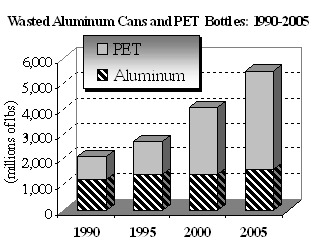
Aluminum beverage cans wasted in the United States
Recycling Rates for PET Plastic and Aluminum in Sweden and the U.S.
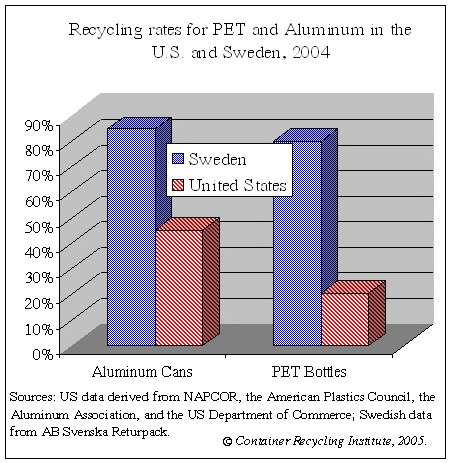
Recycling Rates for PET Plastic and Aluminum in Sweden and the U.S. (2004) Related graphs: Recycling Rate for Aluminum in Sweden and U.S. (1984-2004) Recycling Rate for PET bottles in Sweden and U.S. (1994-2004)
Recycling rate for aluminum cans in Sweden and the US
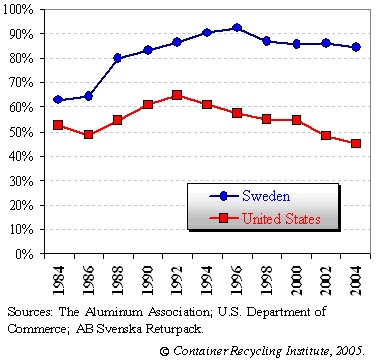
Recycling Rates for PET Plastic and Aluminum in Sweden and the US (1984 – 2004) Recycling Rate for Aluminum Cans in Sweden and the U.S. (1984-2004) The Swedes have an impressive over 80% aluminum can recycling rate, which makes our US efforts look comparatively weak, at a rate of under 50% that’s been backsliding from […]
Number of aluminum cans recycled and wasted in the US
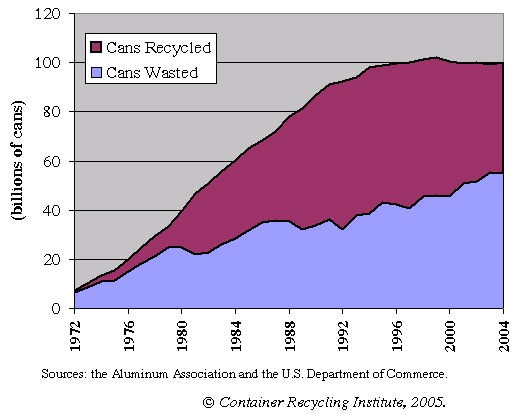
Number of Aluminum Cans Recycled and Wasted in the U.S. from 1972-2004 In the year 2004, 100.5 billion aluminum beverage cans were sold for domestic consumption. Of this, 55.0 billion were not recycled. The volume of wasted aluminum beverage cans has increased by 760% since 1972, when 6 billion cans were wasted.
Aluminum can recycling and access to curbside recycling
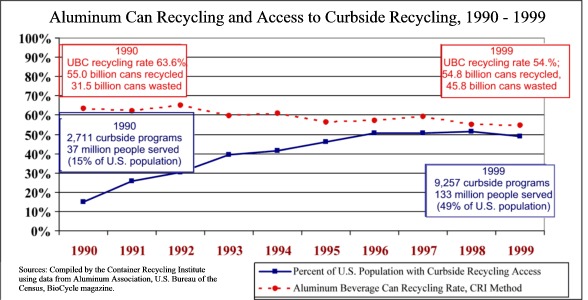
Aluminum Can Recycling and Acces to Curbside Recycling Aluminum Can Recycling and Access to Curbside Recycling Curbside recycling expanded dramatically in the nineties, growing from 2,711 programs in 1990 to 9,257 programs in 1999. During that period, the number of Americans served by curbside recycling increased from 37 million to 133 million. The […]
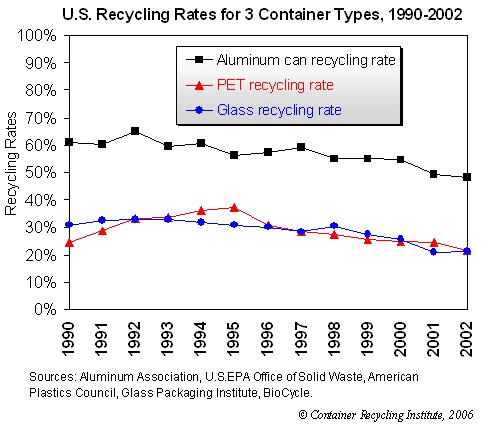
US recycling rates for 3 container types
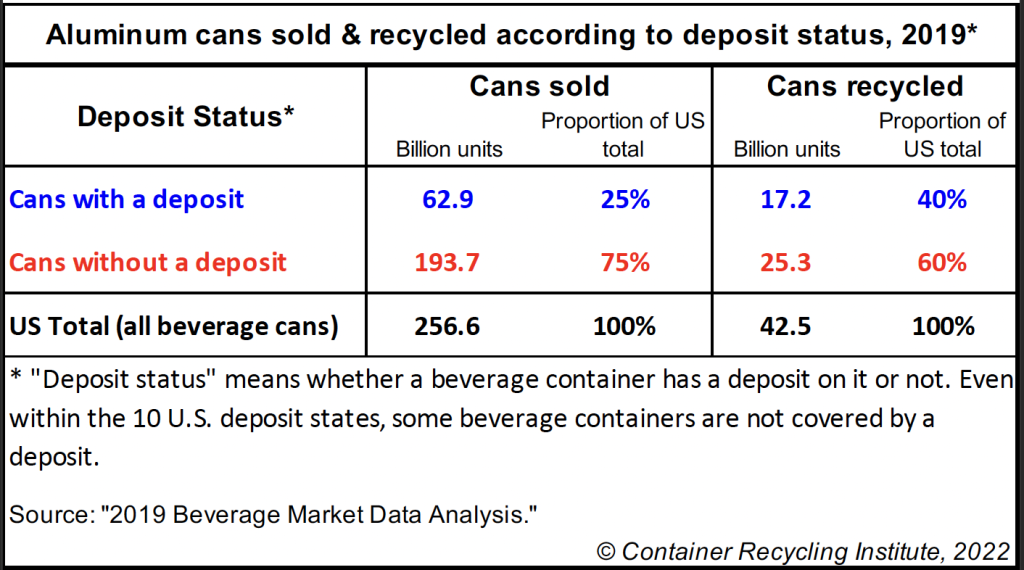
Aluminum cans sold and recycled by deposit status, 2019
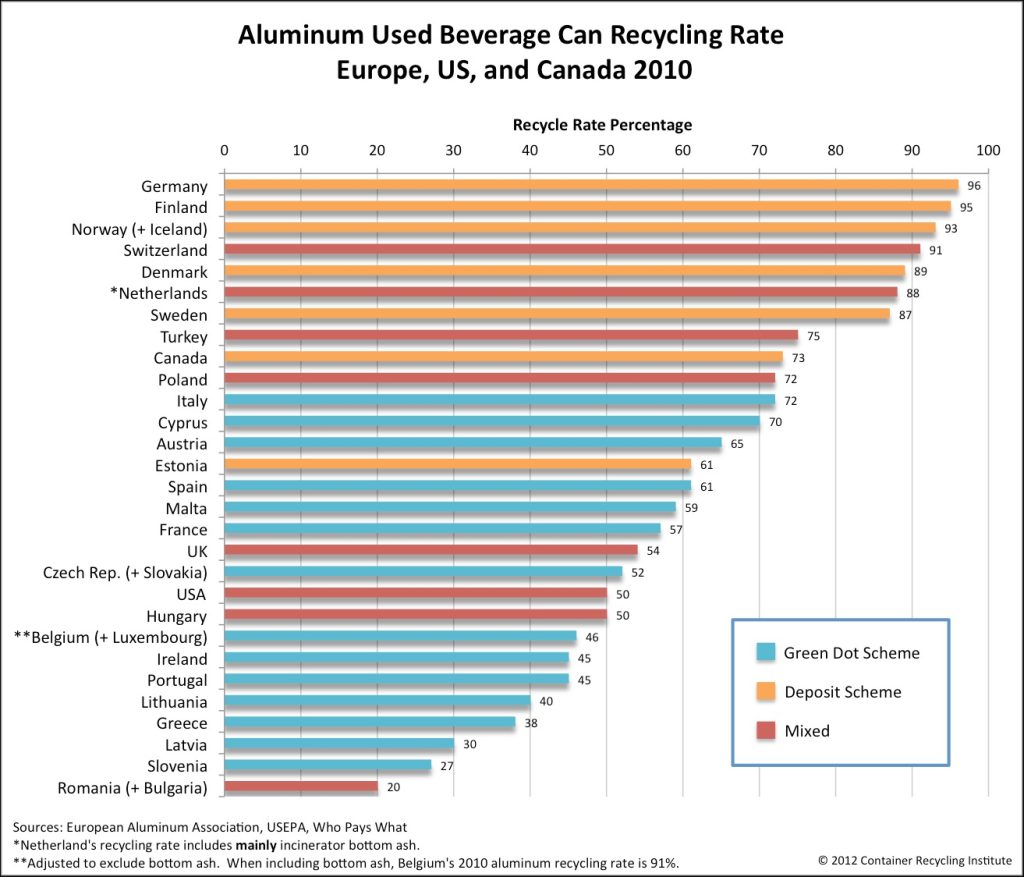
Aluminum Recycling Rates 2010: A Comparison Between the European Nations, U.S., and Canada
Aluminum can recycling rates: 2 methods
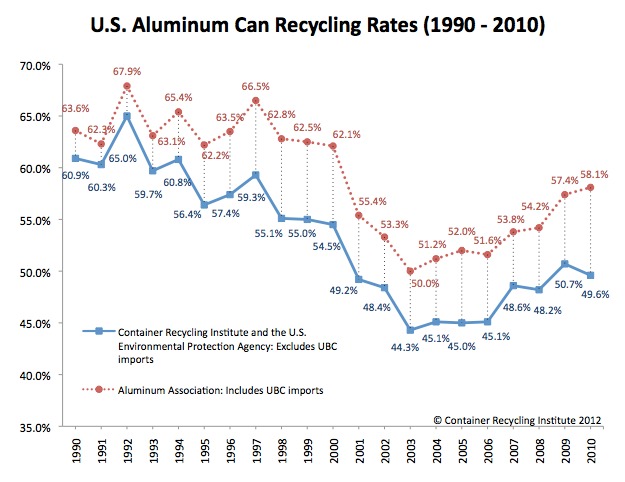
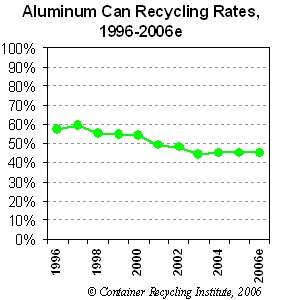
Aluminum Can Recycling Rates (1990-2010) The U.S. aluminum can recycling rate dropped to 45.1% in the year 2004— twenty percentage points below the 1992 peak of 65%. NOTE: Recycling rates have been adjusted to reflect imported used beverage cans recycled in the U.S. but not produced or sold in the United States. In a letter […]
Market share by beverage and package
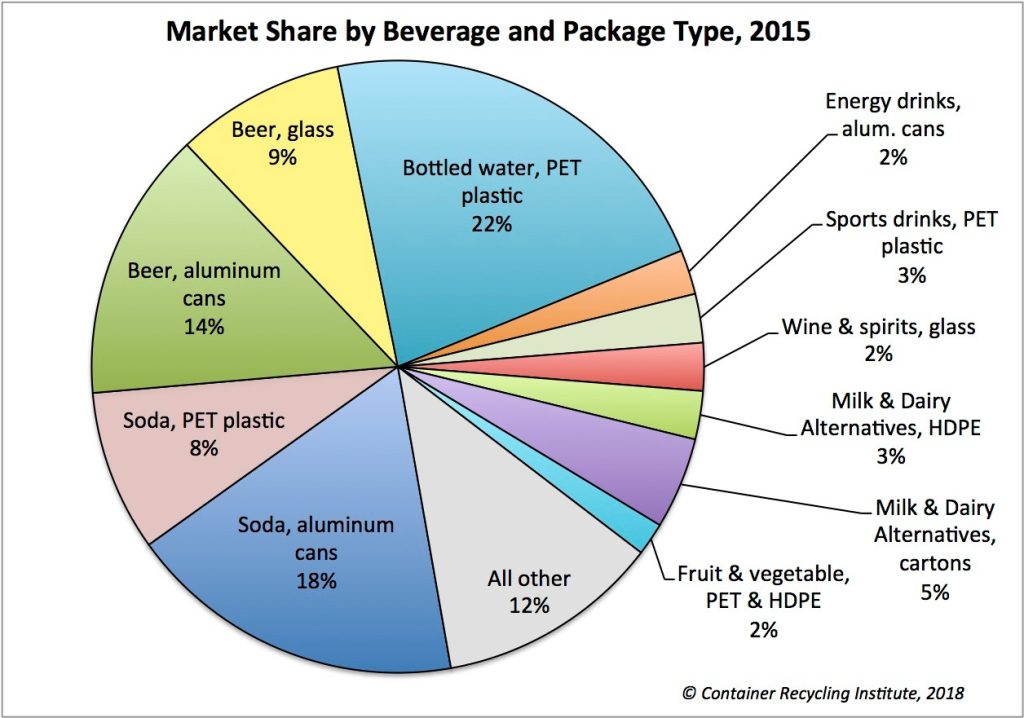
Market share by beverage and package Market share by beverage and package Carbonated soft drinks in aluminum cans has held steady as the single largest component of the total beverage market in 2006 at 28%—63 billion units sold. For the first time, sales of PET plastic water bottles and aluminum beer cans are nearly […]
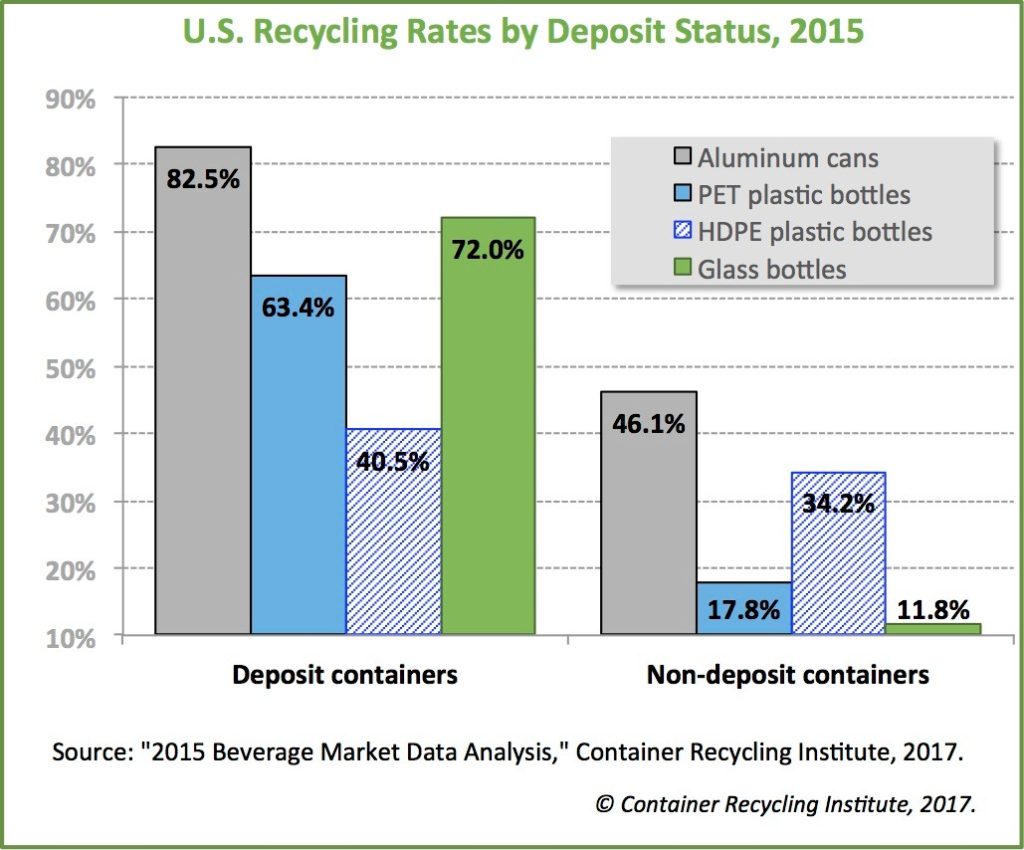
Recycling Rates by Material and Class
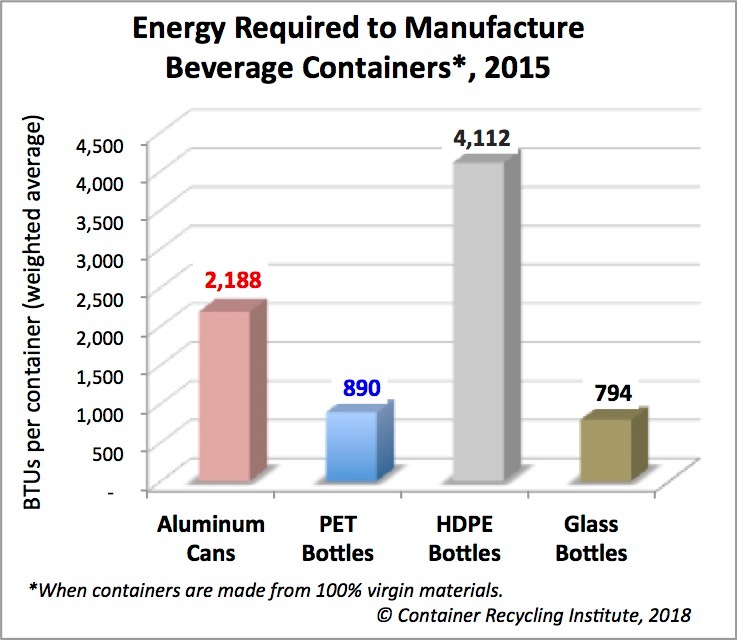
Energy required to manufacture beverage containers
Sales by container type
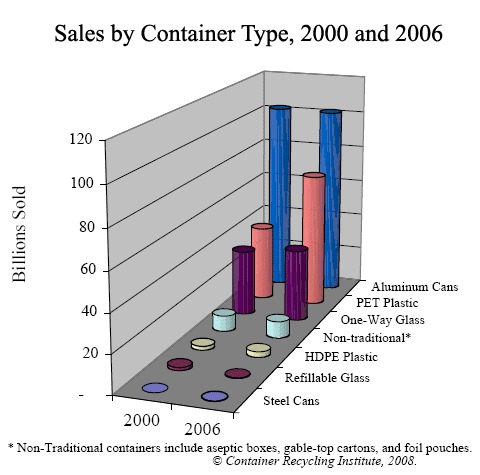
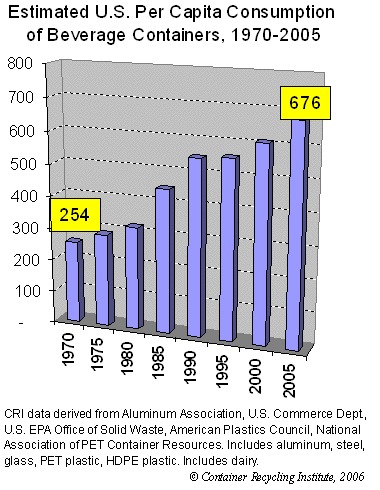
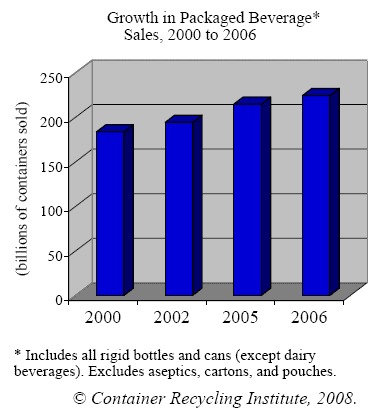
Sales by container type 224 billion packaged beverages were sold in the U.S. in 2006, up from 190 billion in 2000. This equates to 750 bottles and cans sold per capita: more than three times as much as the average person consumed in 1972 (254 units). Market share by container type Of these 224 billion […]
Aluminum, plastic, and glass recycling rates
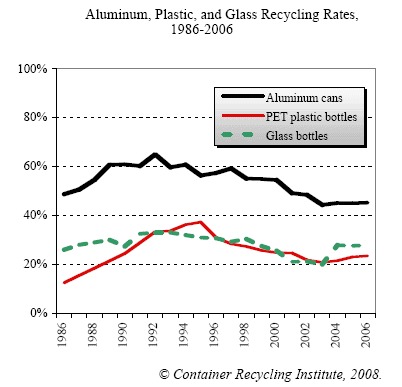
Aluminum, plastic and glass recycling rates Aluminum cans are the most-recycled major container type in the United States, with a 45% U.S. recycling rate. This rate is down nine percentage points from the 54.5% aluminum can recycling rate in 2000, and it is down twenty percentage points from the peak of 65% in 1992. […]
Beverage containers wasted: 1986 and 2006
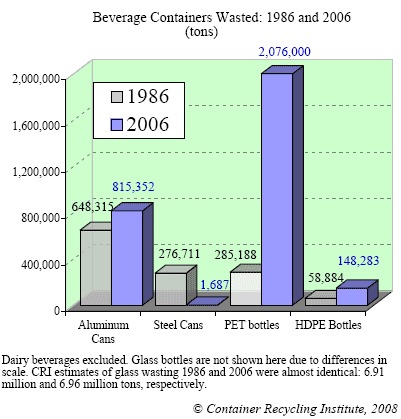
Beverage containers wasted by material: 1986 and 2006 In 1986, 648,315 tons of aluminum cans were wasted (not recycled), but in 2006 815,352 tons were wasted. In 1986, 276,711 tons of steel cans were wasted, but only 1,687 tons were wasted in 2006. 285,188 tons of PET bottles were wasted in 1986, while 2,076,000 tons […]
Energy Impacts of Replacing Beverage Containers Wasted

Energy Inpacts of Replacing Beverage Containers Wasted in 2005 (estimated) Energy Impacts of Replacing Beverage Containers Wasted in 2005 (estimated) Container Type Energy Per Ton Wasted (MBtu) (a) Containers Wasted, 2005 (b) Energy Wasted Due to “Replacement Production” (c) Units (billion) Tons (million) Barrels of Crude Oil Equivalent (million) Households’ Total Annual Energy Needs […]
Greenhouse Gas Impacts of Replacing Beverage Containers Wasted

Greenhouse Gas Impacts of Replacing Beverage Containers Wasted in 2005e Greenhouse Gas Impacts of Replacing Beverage Containers Wasted in 2005e Container Type Greenhouse Gases Per Ton Wasted (MTCE) (a) Containers Wasted, 2005 (b) Greenhouse Gas Emissions Due to “Replacement Production” Units (billion) Tons (million) (million MTCE) # cars with equivalent annual emissions (million) (c) Aluminum […]
Recycling and Wasting in the US for PET beverage bottles and aluminum cans
Aluminum can sales and recycling in the US-
Aluminum can sales and recycling in the US
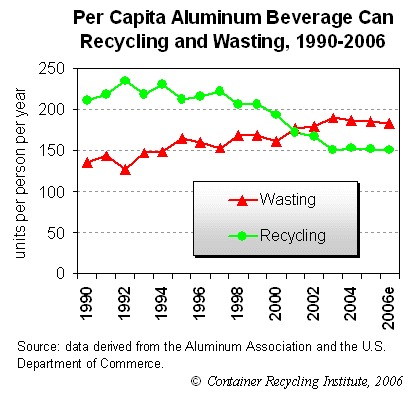
Per capita aluminum beverage can recycling and wasting
Aluminum can sales and wasting in the US-
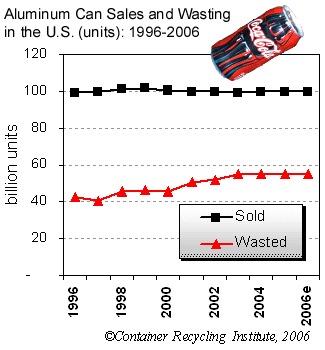
Aluminum can sales and wasting in the US
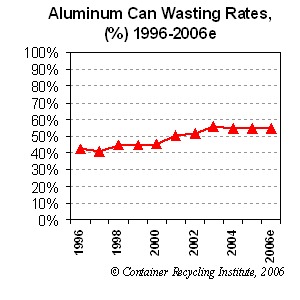
Aluminum can wasting rates
Aluminum can recycling rates
PET bottle sales and wasting in the US
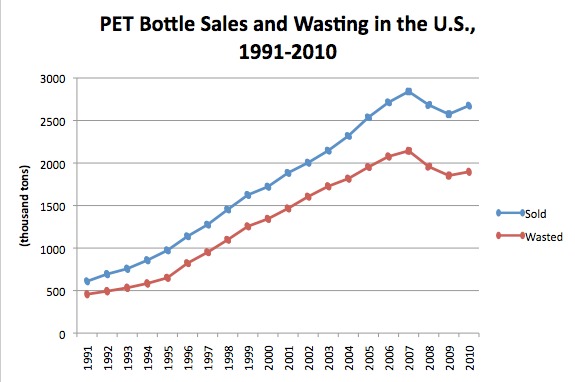
PET Bottle Sales and Wasting in the U.S., 1991-2006* YEAR SOLD thousand tons RECYCLED thousand tons Recycling rate WASTED thousand tons 1991 609 152 24.9% 457 1992 694 201 29.0% 493 1993 757 224 29.6% 533 1994 857 273 31.9% 584 1995 973 322 33.1% 650 1996 1,138 316 27.8% 822 1997 1,276 325 25.4% […]
KGO ABC TV-7 San Francisco, CA: SB 38 Would Fix California’s Broken Bottle and Can Recycling System
The Impact of Deposit Return Systems on Beverage Sales, July 2023
Indisposable Live®: How US Bottle Bills are Accelerating Reuse
Impact of DRS on Beverage Sales-presentation – CRI & Reloop
U.S. Senate Subcommittee Hearing on Beverage Container Waste with CRI Testimony
The Zero Waste Climate Solution
Explain Maine Bottles and Cans
Reloop + CRI New Video (Short Version)
Reloop + CRI New Video (Full Version)
ABC7 California’s Closing Recycling Centers
5900 Wilshire – August 13th, 2017 – Container Recycling Institute
KNBCHD 2017-08-03 Container Recycling Institute Art Installation
KDOCHD 2017-08-03 Container Recycling Institute Art Installation
LA Times – CRI Art Installation
Hermosa Beach has been trashed
Keep Michigan First
Future of bottle bill being discussed
South Australia Container Deposit Scheme
Sean Hammond Interview – Deposit Law Michigan
Michigan Deposit Law Interview with Sean Hammond
Big brands are testing reusable containers this year — would you buy in?
How does a deposit return scheme work
Susan Collins on PRI “A Better Plastic”
Sustainable Materials Management in America’s Zero-Carbon Action Plan
Most California Grocery Stores Won’t Redeem Bottles and Cans
Recycling a coffee cup
CRI on KNX1070
KQED On California’s Beverage Container Recycling Fund
Plastic City: Redemption
Plastic made from pollution hits U.S. market
China’s ‘Green Fence’ is cleaning up America’s dirty recycling
The Recycling Process (Germany)
Innovative Recycling Loop
CarbonLite: Inside the World’s Largest Plastic Bottle Recycling Plant
How does a Material Recovery Facility (MRF) work?
Exclusive! Coke Finally Breaks Their Silence
Susan Collins, Executive Director, Container Recycling Institute for Don’t Waste LA
Plastics News Now: Recycling machine dispenses food for stray dogs, cats
Plastic Pollution in the World’s Oceans
Does Recycling Actually Help?
Where Does My Nickle Go?
Bottle-to-Bottle: The Future of Recycling?
The Diane Rehm Show on NPR: New Challenges To Recycling In The United States
The Story of Ripple Glass
CRI Susan Collins at NOLA
Check out this news coverage of a proposed container deposit-refund program for Nevada:
Check out this informative video on glass bottle recycling:
Bottle Holding Garbage Can Ring
Recycling so easy, even a baby can do it!
Wonder what curbside sorting looks like in the UK? Watch this video and see for yourself:
How a humongous garbage patch in the Pacific breeds new bugs
The Envirobank
Novelis President and CEO Phil Martens Answers the Question: “Why 80% Recycled Metal?”
Starting a Bottle Bill in Portugal!
Environment Minister supports Cash for Containers at Cooks River 2012
Endless Possibilities
Japan tsunami debris spotted, on course to hit US
Recycling Controversy
Susan Collins at the Surfriders Foundation Rise above Plastics Speaker Program
Texas Bottle Bill – The Problem of Plastics
“One Nickel at a Time” – Texas Bottle Bill
Texas Bottle Bill – Buffalo Bayou – From Street to Stream
The Other Side of Single Stream
Challenges Remain as Lawmakers Debate Amendments to Bottle Bill
The Problem of Plastics in Texas
CRI Supports TX HB 2048 – April 23, 2025
CRI supports Texas HB 2048 to establish Texas’ beverage container recycling program.
Wasting and Recycling Trends:Conclusions from CRI’s 2008 Beverage Market Data Analysis
January 2009 | Three pronounced trends in American beverage consumption and recycling patterns have emerged since 2000: overall sales growth, non-carbonated sales growth, and stagnating recycling rates—all of which lead to increasing wasting. Using data from the 2008 Beverage Market Data Analysis, CRI has compiled a report discussing those trends.By Container Recycling Institute
Understanding economic and environmental impacts of single-stream collection systems
December 2009 | While single-stream recycling is more convenient for consumers and results in lower costs than other collection systems, it also results in more contamination of collected materials, lower material quality, and increased waste. Using data from industry reports and interviews with recyclers, this report that highlights the economic and environmental impacts of switching […]
Returning to Work:Understanding the Domestic Jobs Impacts from Different Methods of Recycling Beverage Containers
December 2011 | While the recycling’s impact on jobs has been the subject of several studies in recent years, Returning to Work is the first report to take into account the vital importance of material quality, throughput quantities, processing dynamics and end-user needs to analyze the net gains in domestic jobs when beverage containers are recovered through recycling.By […]
A Common Theme: Single Stream Recycling
Is single-stream recycling service the salvation of all recycling programs or is there a better way forward? Our author digs into the untold story of real residue rates and a PREFERABLE METHOD to truly recycle more materials at materials recovery facilities.
Bottled Up (2000-2010) – Beverage Container Recycling Stagnates
Three pronounced trends in American beverage consumption and recycling patterns have emerged since CRI’s first BMDA looked at year 2000 data: overall sales growth, non-carbonated sales growth, and stagnating recycling rates—all of which are resulting in higher rates of landfilling, incineration and littering, and other negative environmental impacts.
The Environmental and Economic Performance of Beverage Container Reuse and Recycling in British Columbia, Canada
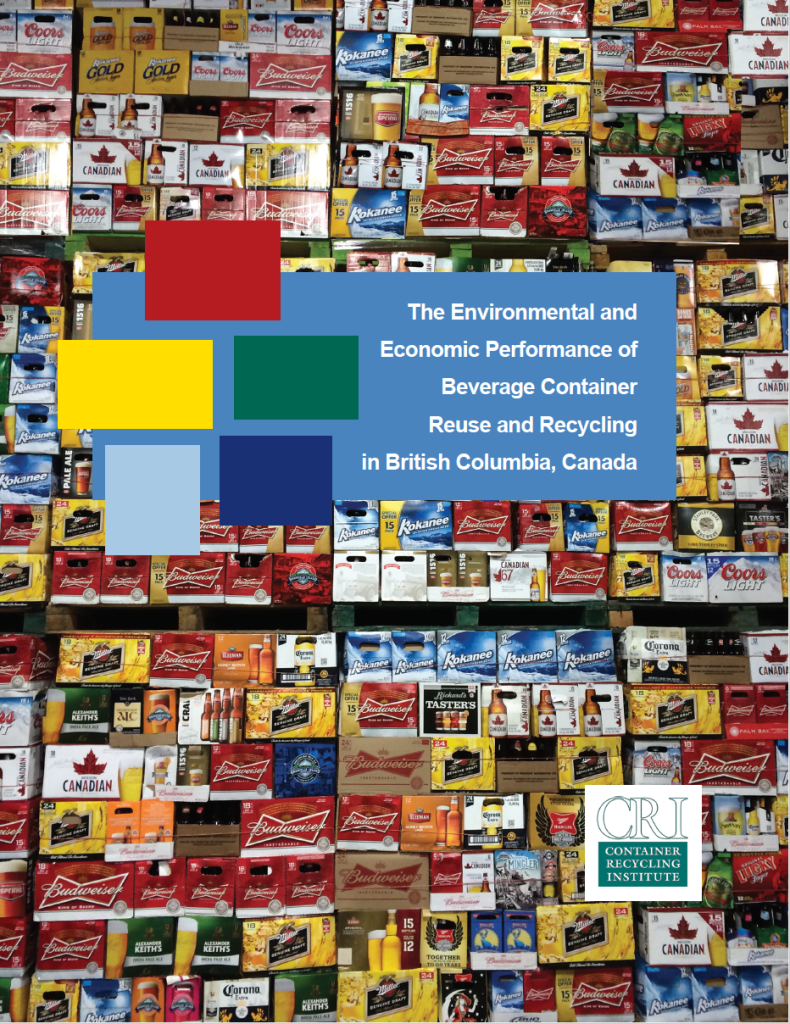
The Container Recycling Institute (CRI) undertook this case study of British Columbia’s container deposit-refund law (CDL) for two reasons: first, to expand CRI’s existing body of research on best practices for the recovery and quality recycling of packaging materials; and second, to investigate recent increases in container recycling fees (CRF) in the province, especially for […]
Examining the Potential for Increased Revenues in California’s Beverage Container Deposit-‐Return Program (August 13, 2014)
CRI’s analysis suggests that there may be nearly 3.7 billion units (3,690,008,614 units) for which no deposit has been paid. These “free-‐riders” in the system are worth more than $206 million in potentially uncollected CRV.Get Download Link
Sierra Club Report: Analysis of S.379: An Act Improving Recycling in the Commonwealth
An analysis of the effects of passage of S.379 on litter, recycling, employment, and state and local financing.Download PDF [PDF, 117KB]
Exploring refillables in the United States – April 2021
Long before one-way beverage bottles and cans came to dominate drink packaging in the mid-20th century,1 refillables were how Americans—and people around the world—consumed beer, soft drinks, and milk. Download PDF [PDF, 1MB]
“International Embrace” by CRI President Susan Collins (Plastics Recycling Update) – Winter 2020
Over the past several years, container deposit programs have been adopted at a rapid rate in nations across the globe. What’s pushing the trend? And is it a preview of things to come in the U.S.? Download PDF [PDF, 908KB]
CRI’s Comments on the NYSP2I “Impact Study of NYS Bottle Bill Expansion
CRI has undertaken a limited review of RIT’s “Impact Study of NYS Bottle Bill Expansion” (Nov. 2019), which assesses economic impacts on various stakeholders if glass liquor and wine bottles (excluding plastic and aluminum containers) were to be covered by a deposit. Download PDF [PDF, 874KB]
California’s CRV Beverage Container Recycling Program: Quantifying Payments to Curbside and Drop-off Programs (2017) – Updated August 2019
Summary of Findings: The operators of curbside and drop-off programs in California received $193 million in revenue from CalRecycle payments and scrap sales for CRV beverage containers in 2017. The estimated cost for handling those containers was $43 million, leading to a calculation of $150 million in gross profits, or a 349% profit. Download PDF […]
Background on California’s Convenience Zone Structure and Current Status – April 2019
A “convenience zone” is defined as the area within a half-mile radius of a supermarket that has gross annual sales of at least $2 million. By statute, the intent is to have one redemption center in each convenience zone. This would ensure that it is just as easy to return an empty beverage container for […]
CRI Analysis of Massachusetts House Bill 2686*(repeal of Bottle Bill with penny fee on beverage containers for 3 years) – April 2018
House Bill 2686*, “An Act Improving Recycling in the Commonwealth” would repeal the existing beverage container deposit law (the “bottle bill”), and in its place would impose a 1-cent fee on all carbonated and non-carbonated beverages. Collected revenues would be put into a “Municipal Recycling Enhancement Fund” (the Fund), with funding to be used for […]
Cost of Curbside Recycling for Beverage Containers – October 18th, 2018
As all recycling professionals know, recycling isn’t a zero-cost service, even though it is often provided for “free” to households. Providing recycling for “free” is a deliberate policy decision made by municipalities to incentivize participation by residents and businesses. Download PDF [PDF, 228KB]
Winners and Losers Under Iowa House File 575: An Analysis – March 2018
The Container Recycling Institute (CRI) has analyzed Iowa HF 575, successor to HSB 163.1 It would repeal the beverage container deposit law (“bottle bill”), and would impose a 1¢ “recycling program fee” on carbonated beverages. Download PDF [PDF, 684KB]
Massachusetts Container Deposit Return System: 2016 Employment and Economic Impacts in the Commonwealth (June 2017- Addendum April 2018)
This report examines a suite of economic impacts associated with the existing Massachusetts “Bottle Bill” (originally passed as the Beverage Container Recovery Law; H.2943/S.1588). Get Download Link [PDF, 471KB]Addendum April 10th, 2018 – Download PDF [PDF, 32KB] Updated Imagery included here: Download PDF [PDF, 283KB]
California’s Beverage Container Redemption Center Crisis: THE BIGGEST LOSERS (July, 2017)
California needs to help restore redemption center coverage in the “recycling deserts” in the state. Here’s why. (July 2017) Download PDF [PDF, 29KB]
Cullet Comparisons – February 2017
Jurisdictions across North America are pondering how to handle the challenging economics of glass recovery. A beverage container recycling specialist adds to the conversation with an in-depth look at the numbers from different glass programs around the globe. Download PDF [PDF, 5.9MB]
Understanding Delaware’s Universal Recycling Law (Updated: February 2017)
The American Beverage Association (ABA) recently released an “Issue Analysis” which examines the impacts of Delaware’s new Universal Recycling Law, implemented in 2011. The Container Recycling Institute (CRI) has prepared this fact sheet to provide additional information not currently presented in ABA’s analysis.Download PDF [PDF, 602KB]
Integrity of California’s Beverage Container Deposit System Threatened by Processing Payment Shortfalls – Report (Updated: April 2016)
Declining scrap prices coupled with problematic compensation formulas have produced processing payment shortfalls that have already forced the closure of more than 400 redemption centers in California, posing a serious threat to the state’s beverage container recycling infrastructure and sharply constricting consumers’ ability to recover the CRV (container refund value) to which they are entitled.Download […]
Processing Payment Shortfall FactSheet (Updated: April 2016)
Though it would require a statutory change, CRI recommends that the processing payment calculation method be reevaluated to protect the solvency of the recycling centers upon which the California beverage container recycling infrastructure depends.Download PDF [PDF, 310KB]
BC Case Study: The Environmental and Economic Performance of Beverage Container Reuse and Recycling in British Columbia, Canada – August 2015
The Container Recycling Institute (CRI) undertook this case study of British Columbia’s container deposit-refund law (CDL) for two reasons: first, to expand CRI’s existing body of research on best practices for the recovery and quality recycling of packaging materials; and second, to investigate recent increases in container recycling fees (CRF) in the province, especially for […]
Comparative Table of Container Deposit States Inclusion of Cider in Respective Container Deposit Laws – July 2015
Comprehensive list of Container Deposit States that do include Cider in their container deposit laws.Download PDF
Estimating Beverage Container Litter Quantities and Cleanup Costs in Michigan – April 2015
This paper looks at litter cleanup efforts and associated costs in Michigan, and attempts to determine the proportion of litter composed of discarded beverage containers.Download PDF
Beverage Container Recycling Rate March 2015 Update
Listing of Beverage Container Recycling Rates by State for Deposit Containers Only.Download PDF
Understanding Delaware’s Universal Recycling Law (February 2015)
The American Beverage Association (ABA) recently released an “Issue Analysis” which examines the impacts of Delaware’s new Universal Recycling Law, implemented in 2011. The Container Recycling Institute (CRI) has prepared this fact sheet to provide additional information not currently presented in ABA’s analysis.Download PDF
Comparison of Container Deposit Programs in the United States (September 2014)
This paper compares state specific container deposit program information. Because of different reporting requirements across beverage container deposit states some information was obtained from some states, while the same information was not available from other states.Download PDF
CRI Releases 2025 Impact Report – Learn How We Made a Difference
PDF Download
UPDATED: The Status of EPR-PPP and DRS Around the World (Factsheet) – October 2025
PDF Download
Beverage Container Redemption in Connecticut: A Model for Successful Modernization – August 2025
PDF Download
CRI Releases 2024 Impact Report – Learn How We Made a Difference
PDF Download
The Status of EPR-PPP and DRS Around the World (Factsheet) – May 2025
PDF Download
CRI Releases 2023 Impact Report – Learn How We Made a Difference
PDF Download
Updating the Massachusetts Beverage Container Deposit Law: Estimated Unclaimed Deposits – March 2024
PDF Download
Estimates of Deposit Beverage Containers Captured Through Curbside and Dropoff Programs – February 2024
PDF Download
Benefits to Modernizing the Michigan Bottle Bill – January 2024
PDF Download
Why Modernizing the Bottle Bill Would Help Fight Climate Change – December 5th,2023
PDF Download
Handling Fees Factsheet 2023 – August 2023
PDF Download
CA SB 1013 Summary (September 5th, 2022)
PDF Download
CA AB 179 Budget Act of 2022 Deposit Program Funding Breakdown (September 5th, 2022)
PDF Download
All Redemption States Table (July 2022)
PDF Download
All Redemption States Details (July 2022)
PDF Download
CRI letter toAssembly Committee on Appropriations to Support SB1013 – July 25th, 2022 (updated)
SB 1013 would add wine and spirits containers to the Beverage Container Recycling and Litter Reduction Act, also known as a container deposit law or bottle bill. Download PDF [PDF, 932KB]
Container Recycling Institute Comments on CalRecycle’s Budget Change Proposal (BCP) for the Beverage Container Recycling Program (BCRP) – May 2nd, 2022
The Container Recycling Institute (CRI) has been advocating for reform to California’s beverage container recycling program for more than a decade, and so we are delighted to see the conversation in the legislature turn toward bold proposals and acknowledgement of availability of funding for real program modernization. Download PDF [PDF, 286KB]
CRI supports SB 1013 – California – April 19th, 2022
We are writing in support of SB1013, “An act to amend Sections 14504 and 14550 of the Public Resources Code, relating to recycling, and making an appropriation therefor…Download PDF [364KB]
Background on California’s Convenience Zone Structure and Current Status – May 5 2021 (Updated)
A “convenience zone” is defined as the area within a half-mile radius of a supermarket that has gross annual sales of at least $2 million. By statute, the intent is to have one redemption center in each convenience zone. This would ensure that it is just as easy to return an empty beverage container for […]
How many nips are actually sold in Connecticut per person? July 2021
CRI reviewed the per capita “nips” sales estimates in the “Connecticut Wine and Spirits Industry’s 2-Part Plan for 50 mls (Nips) and Glass Containers” and found that they differed dramatically from our BMDA derivations of “nips” sales (“2018 Beverage Market Data Analysis,” Container Recycling Institute, 2020). Download PDF [PDF, 267KB]
Zero Waste
Setting Our Sights on Zero Beverage Container Waste
Millions of consumers who recycle every day think that because they recycle their bottles and cans, everyone else is recycling too. Unfortunately, that’s not the case. Americans waste (landfill, incinerate, or litter) twice as many beverage containers as we recycle.
In 2006, more than 138 billion beverage bottles and cans were not recycled. Nationwide, that’s about 460 per capita— up from 300 per capita just a decade ago. This trend continued in 2010, with more than 153 billion beverage bottles and cans not recycled; at 495 units wasted per capita! In the four years that passed between 2006 and 2010, the percentage of beverage bottles and cans not recycled increased by 10.9%.
Recycling and Jobs
Facts About Beverage Container Recycling and Jobs
Recycling advocates have long been reporting on the significant jobs benefits of diversion over disposal. Some have focused on the jobs potential in recovering a particular product, such as tires or electronics; some have considered the jobs impacts of recovering a particular material, such as plastics or precious metals; and still others have looked at the jobs benefits of a particular recovery method, such as curbside recycling or composting.
Bottle Bills
The Container Recycling Institute is one of the country’s foremost advocates of beverage container deposit legislation (commonly known as bottle bills). Beverage containers make up a large portion of litter in the United States, and deposit laws are known for achieving a high recycling rate for beverage containers and reducing litter where other recycling systems have failed. Did you know that containers on deposit in the United States have a recycling rate of 64%, while non-deposit containers only reach about 26%?
Extended Producer Responsibility: A Primer
By Pat Franklin
Executive Director
Container Recycling Institute
Presented on November 18, 1997, at the Take it Back! ’97 Producer Responsibility Forum
“The responsibility, that the waste generated during the production processes could be taken care of in a proper way, from an environmental and resource-saving point of view, should primarily be of the manufacturer. Before the manufacturing of a product is commenced it should be known how the waste which is a result of the production process should be treated, as well as how the product should be taken care of when discarded.
Bottled Water
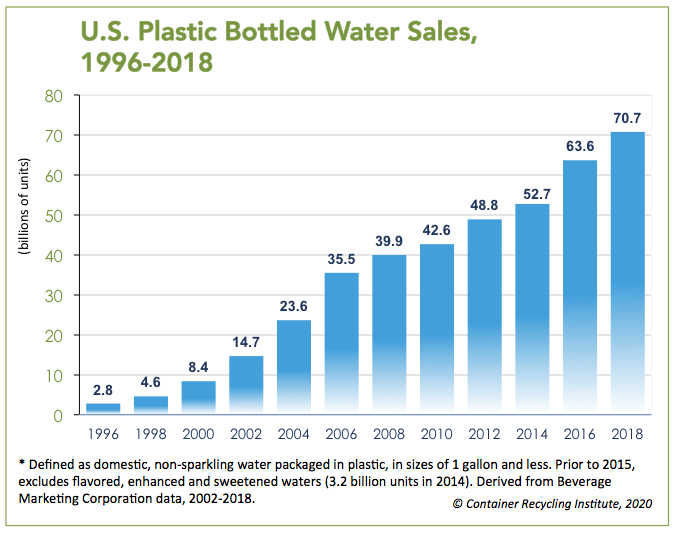
In 2018, Americans bought more than 70 billion plastic water bottles of one gallon or less. 3 out of 4 of them ended up in a landfill or incinerator. Hundreds of millions end up as litter on roads and beaches or in streams and other waterways. In turn, taxpayers pay hundreds of millions of dollars each year for disposal and litter cleanup.
Single Stream Recycling
What is single-stream recycling?
Single-stream recycling is a system in which all recyclables, including newspaper, cardboard, plastic, aluminum, junk mail, etc., are placed in a single bin or cart for recycling. These recyclables are collected by a single truck and taken to a Materials Recovery Facility (MRF) to be sorted into various commodity streams for sale to markets, where it is processed into feedstock which can be used in the manufacture of new products.
CRI Supports CA SB 1341 – June 15, 2026
CRI supports CA SB 1341, a bill that states that a processing fee for boxes, bladders and pouches containing wine or distilled spirits must be established in a way that does not impose an economic burden on beverage manufacturers, while generating sufficient funds to make processing payments to recyclers. In this letter, CRI also discusses […]
Estimated US per capita consumption of beverage containers
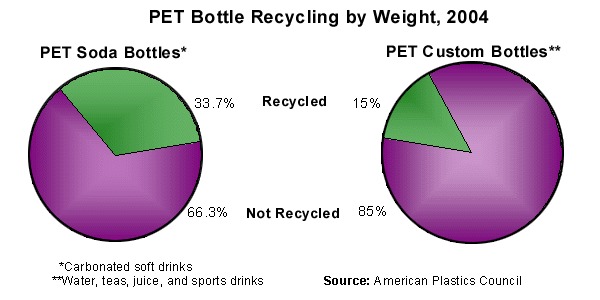
PET bottle recycling by weight
Recycling Rates for PET Plastic and Aluminum in Sweden and the U.S.
Recycling rates in Sweden and the US
PET bottle recycling and wasting: soft drink bottles vs. custom bottles
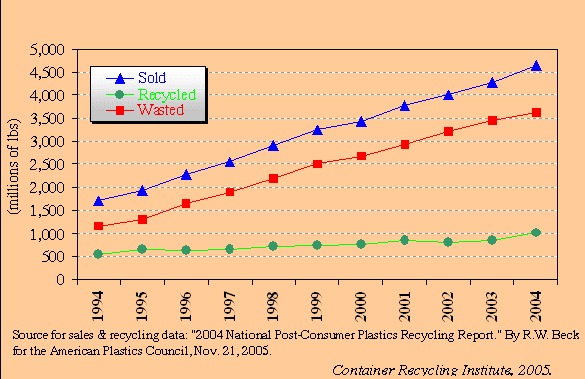
PET sales, recycling, and wasting: soft drink bottles
PET sales, recycling, and wasting: custom bottles
PET sales, recycling, and wasting
Beverage container redemption rates in selected deposit states
Recycling rate for aluminum cans in Sweden and the US
Number of aluminum cans recycled and wasted in the US
Plastic soda bottles wasted
Aluminum can recycling and access to curbside recycling
Percentage of population served by curbside vs. percentage of glass recycled
US Plastic bottled water sales
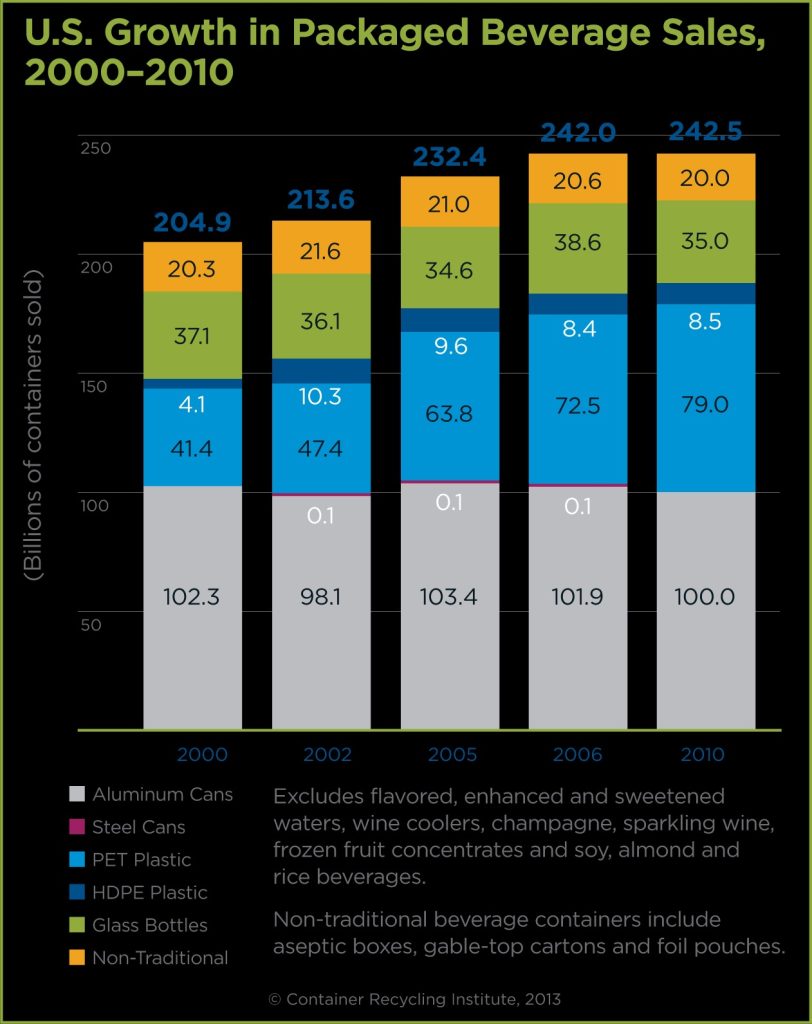
Growth in Packaged Beverage Sales
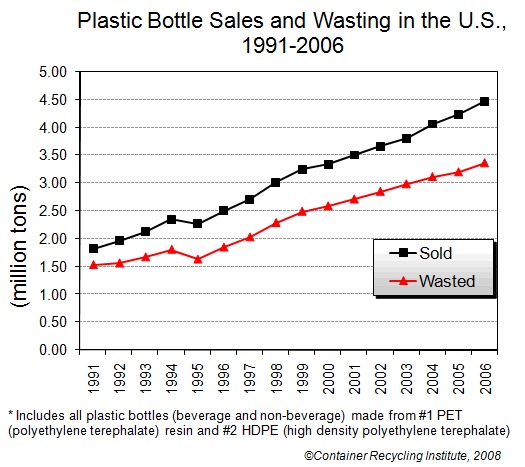
Plastic Bottle Sales and Wasting in the U.S.
HDPE bottle sales and wasting in the US
PET bottle sales and wasting in the US
Aluminum, plastic, and glass recycling rates
Beverage containers wasted: 1986 and 2006
Beverage sales, recycling, and wasting
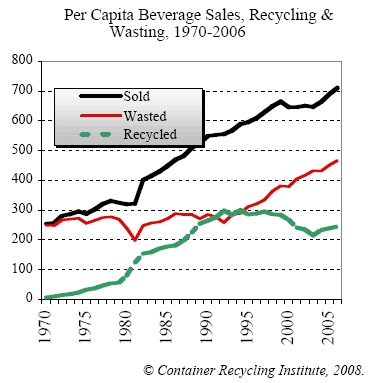
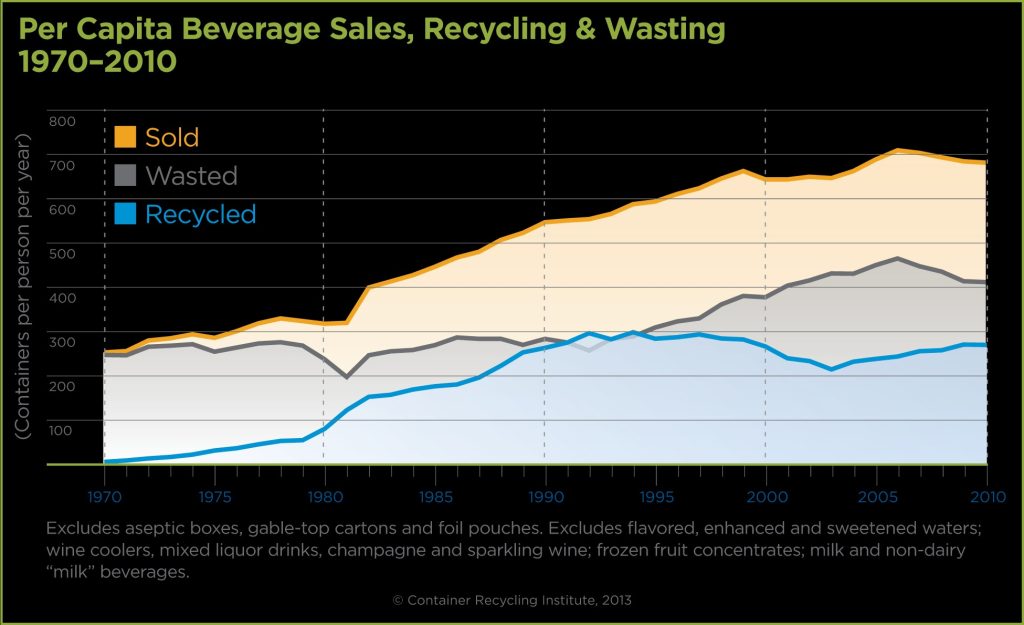
Per capita beverage sales, recycling, and wasting
US bottles and cans wasted in 2005
Aluminum can sales and recycling in the US
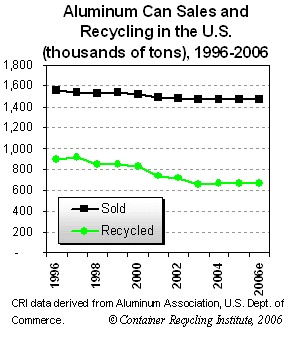
Per capita aluminum beverage can recycling and wasting
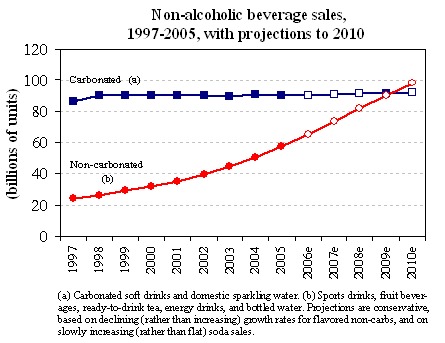
Non-alcoholic beverage sales, with projections to 2010
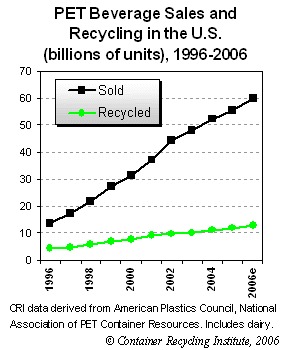
PET beverage sales and recycling in the US
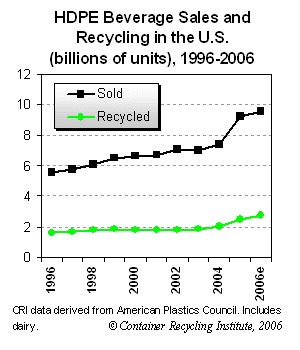
HDPE beverage sales and recycling in the US
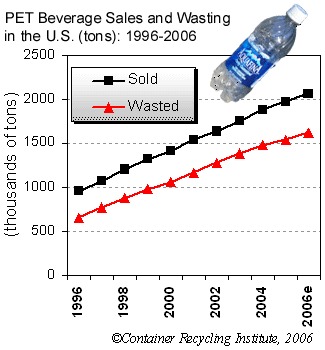
PET beverage sales and wasting in the US
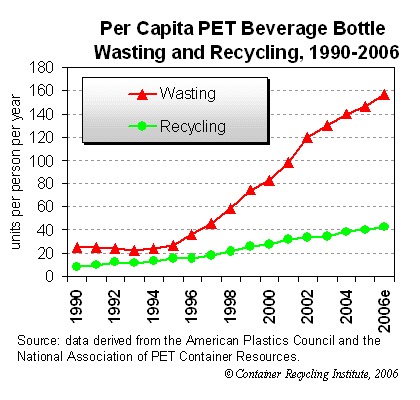
Per capita PET beverage bottle wasting and recycling
Wasted aluminum cans and PET bottles
Aluminum beverage cans wasted in the United States
Energy required to manufacture beverage containers
Beverage Containers Wasted, 2000 & 2010
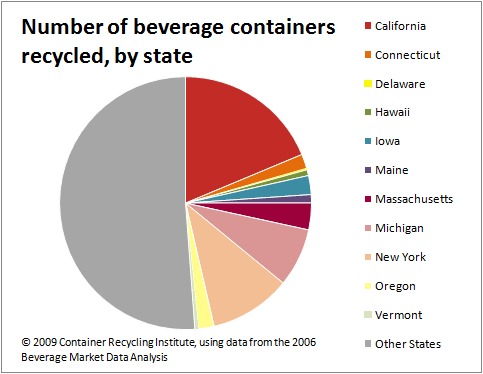
Per Capita Containers Recycled in Deposit and Non-Deposit States – All Container Types
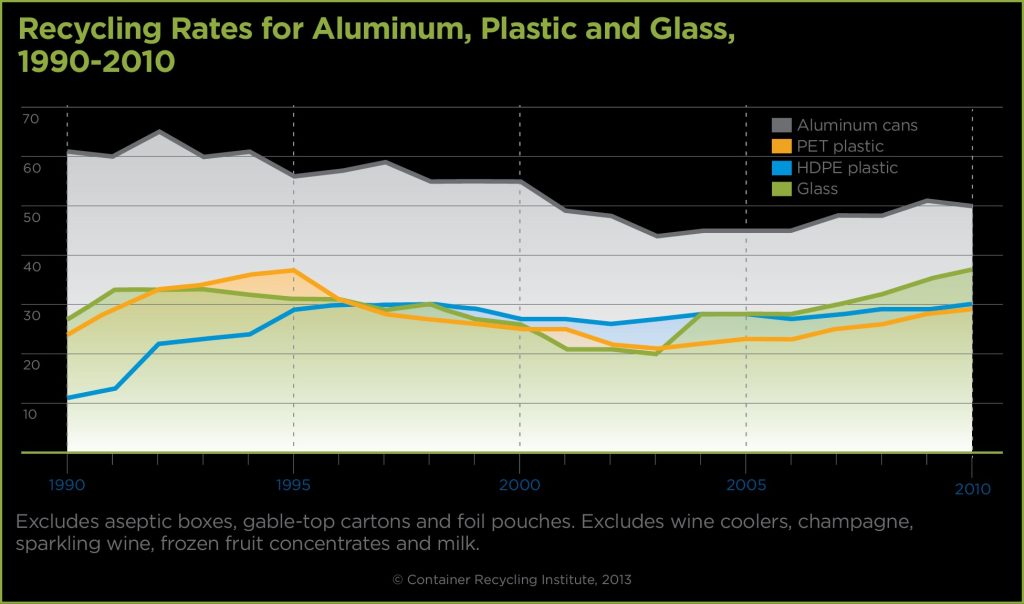
Recycling Rates for Aluminum, Plastic and Glass
Energy Required to Replace Beverage Containers (in U.S. household equivalents)
Greenhouse Gas Emissions from Replacing Wasted Containers
Comparative Energy Requirements for Replacing Wasted Beverage Containers
Energy Required to Replace Beverage Containers
Container Types Used For Beer in the U.S., 1981-2010
Beverage Containers and Municipal Solid Waste
Comparing Curbside Recycling Access and Paper and Paperboard Recycling Rates
PET Recycling vs. Utilization Rates
PET Sales, Wasting, and Recycling
Estimated yield rates from collected plastic
End-markets for collected glass
Recovered PET beverage bottles by state
Recycling rates in bottle bill states and non-bottle bill states
Market share by beverage and package
Recycling Rates by Material and Class
Sales by container type
U.S. Nominal Recycling Rates by Deposit Status, 2023
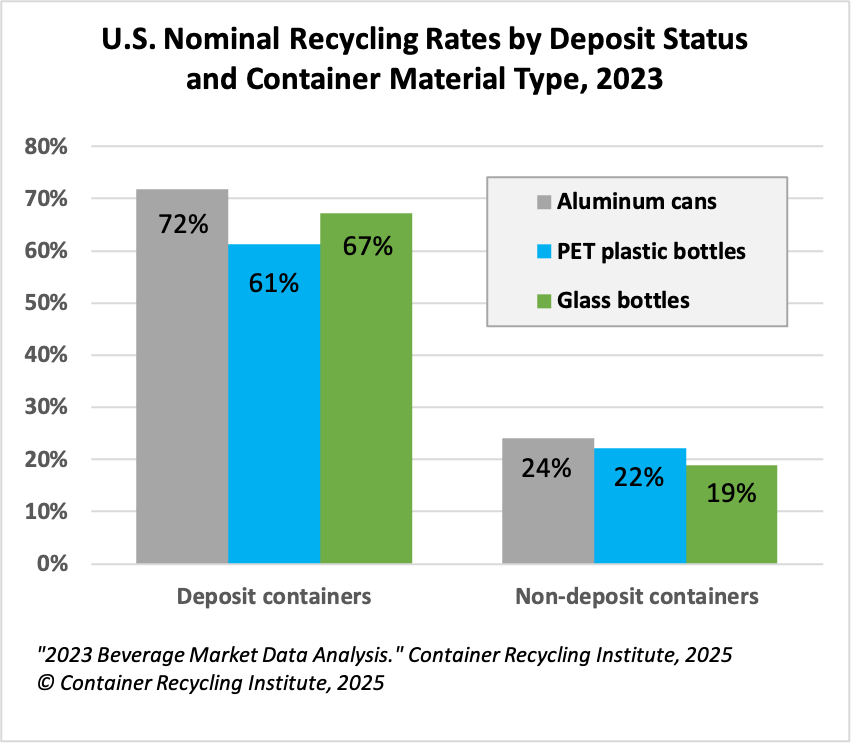
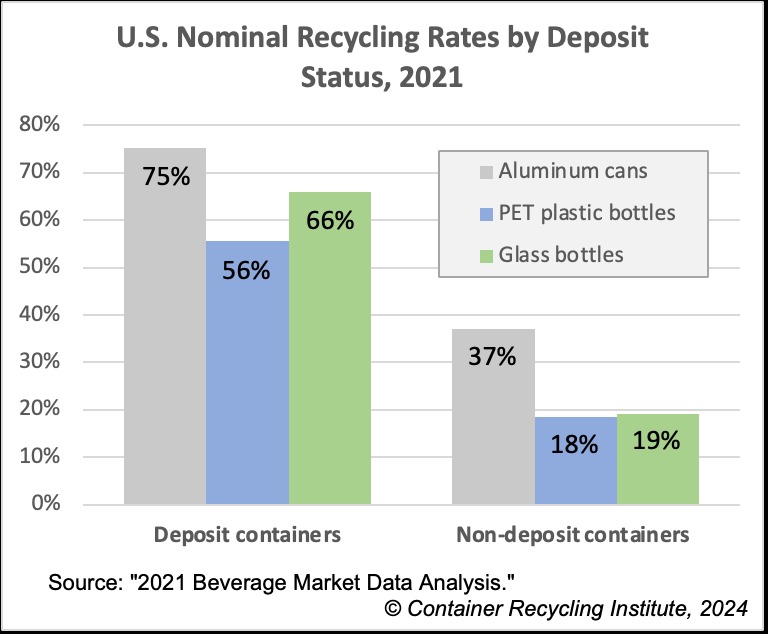
U.S. Nominal Recycling Rates by Deposit Status, 2021
Aluminum cans sold and recycled by deposit status, 2019
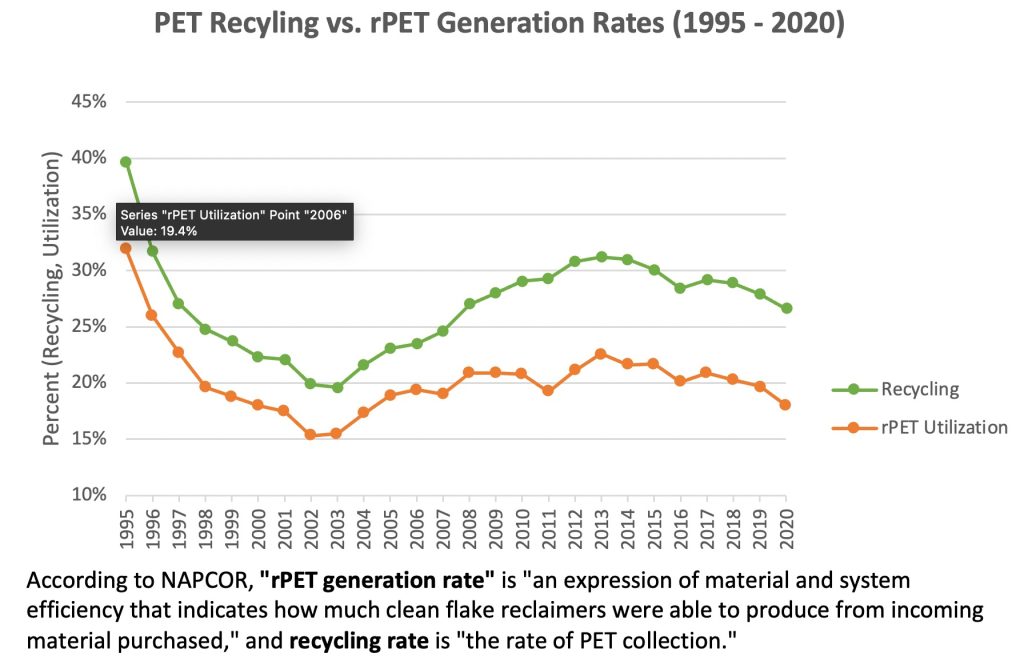
PET Recycling vs. rPET Generation Rates (1995 – 2020)
Beverage Containers Wasted by Material 2010 – 2015 (tons)
Beverage Containers Wasted by Material 2010 – 2015 (units)
U.S. Recycling Rates by Deposit Status, 2015
Financial Analysis Maine LD 1204 for 62/64 Ounce Containers
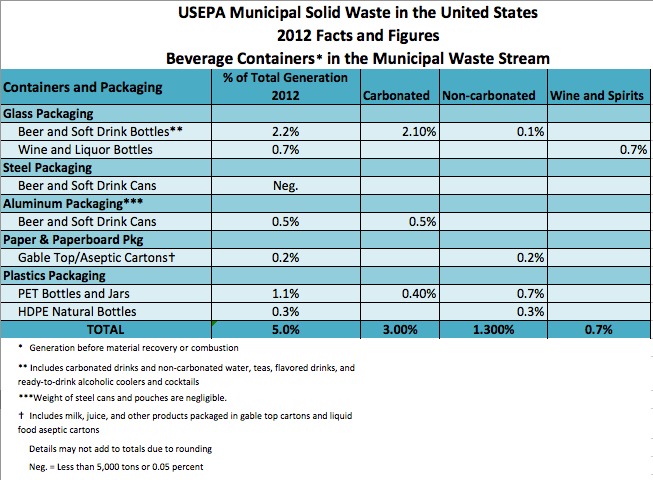
Beverage Containers in the Waste Stream
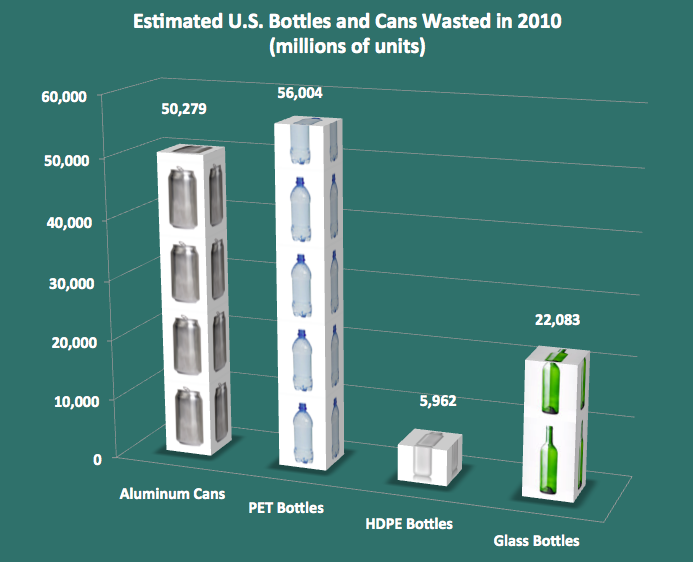
Estimated US Bottles and Cans Wasted in 2010
Deposit States have Higher Beverage Recycling Rates
US Growth in Package Beverage Sales
Per Capita Beverage Sales, Recycling and Wasting
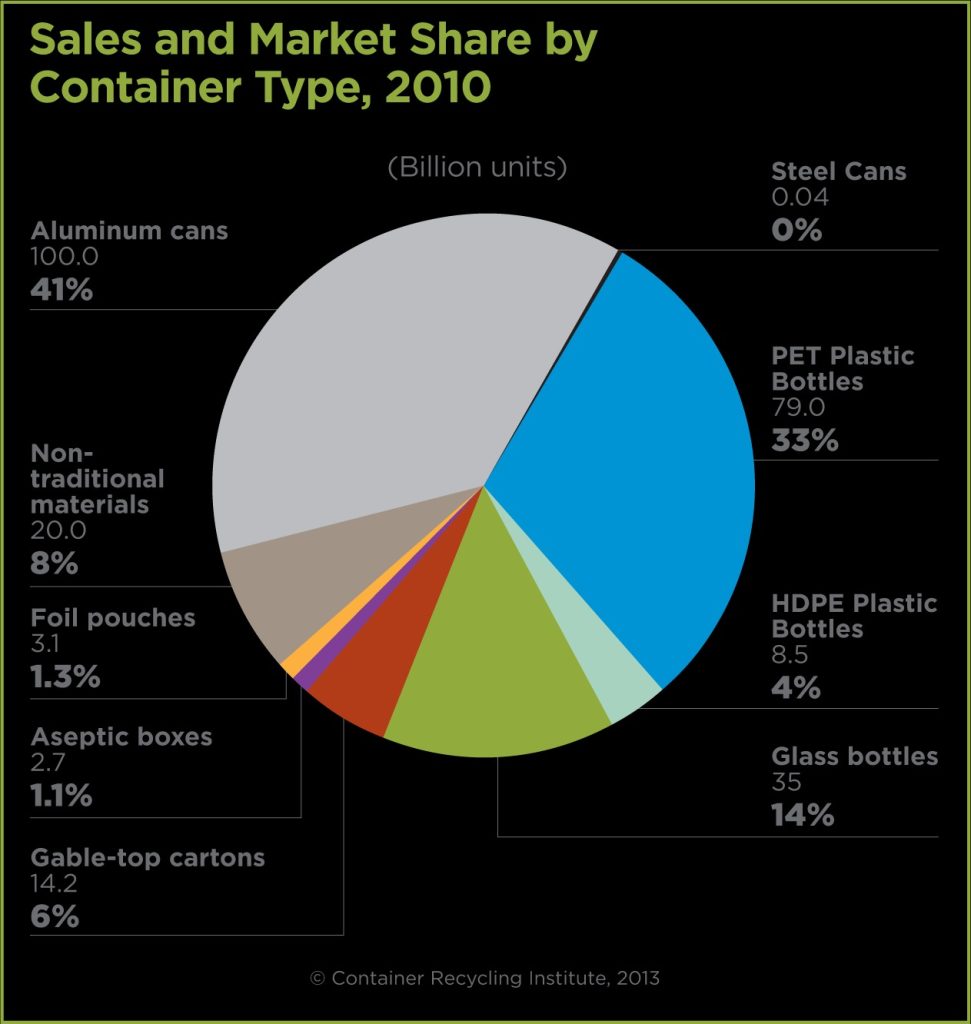
Sales and Market Share by Container Type
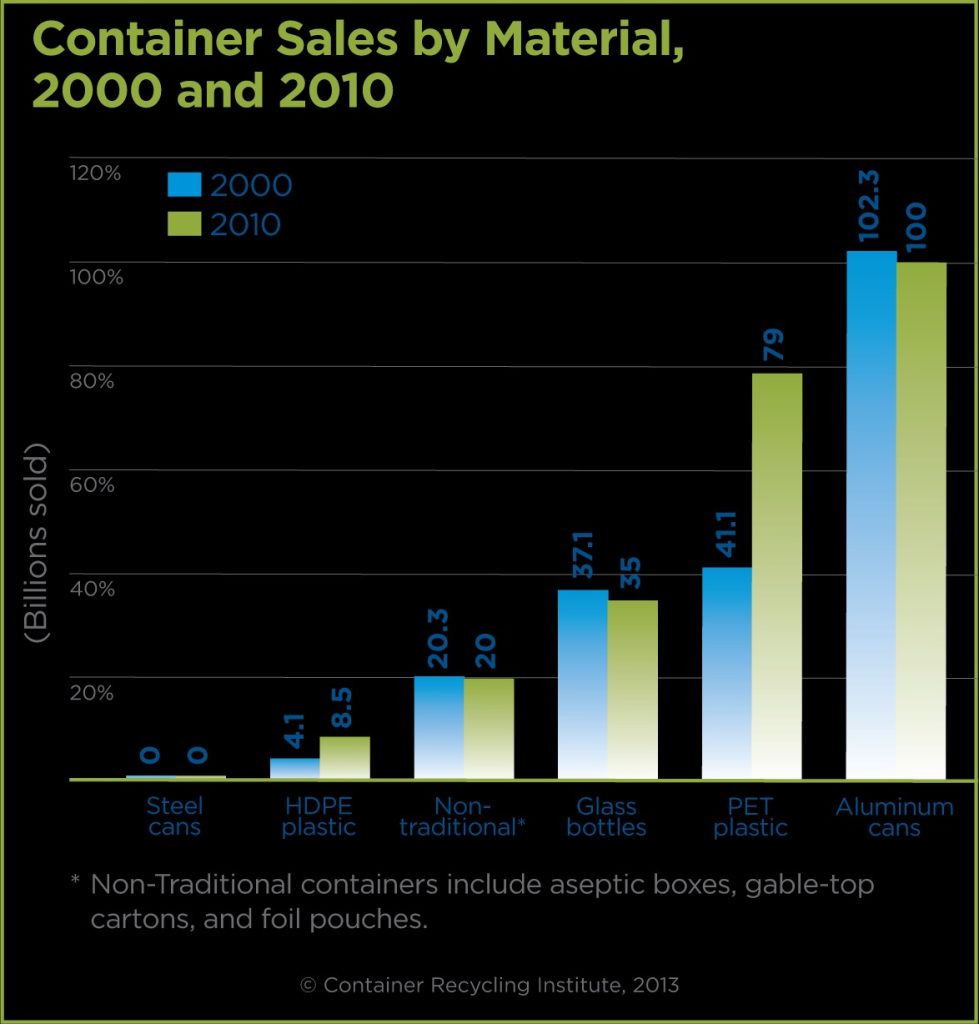
Container Sales by Material, 2000 & 2010
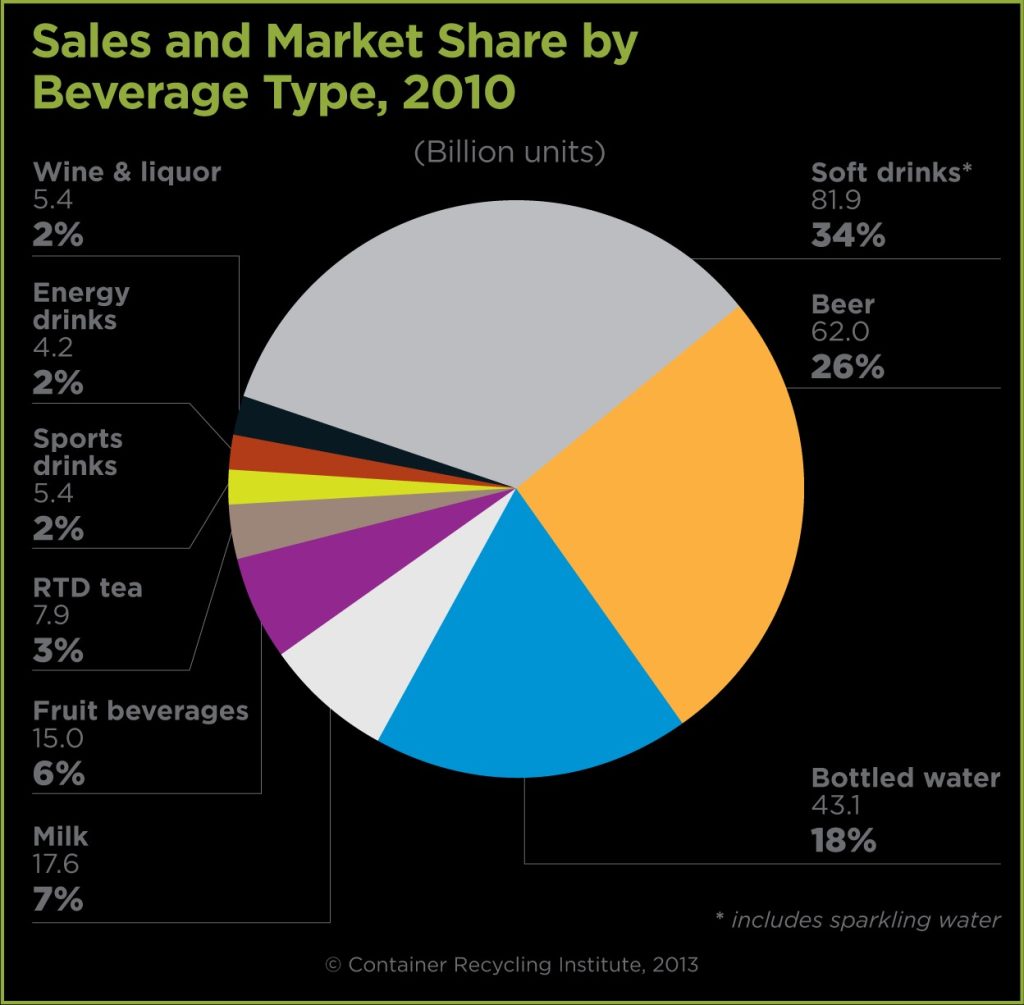
Sales and Market Share by Beverage Type
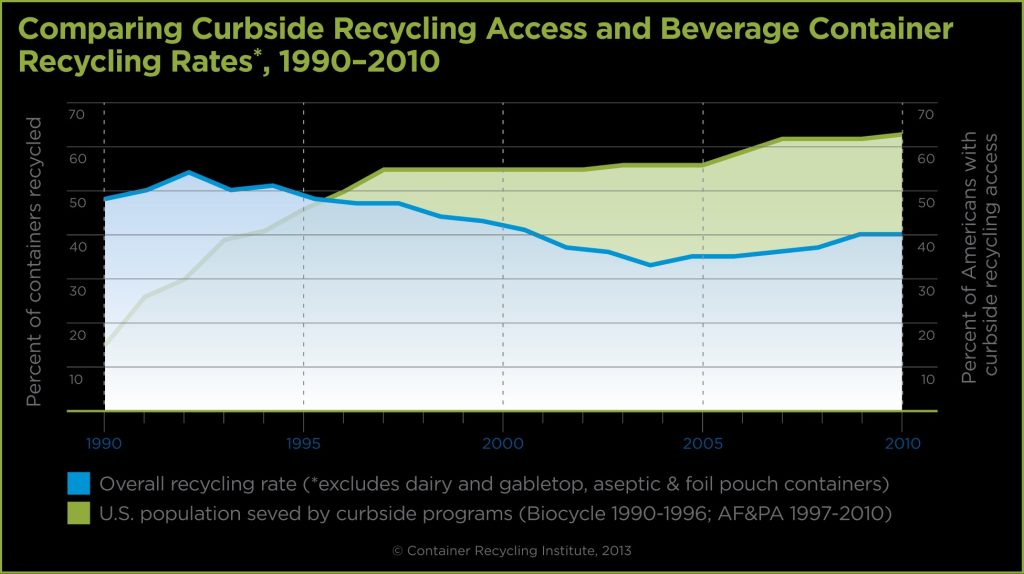
Comparing Curbside Recycling Access and Beverage Container Recycling Rates
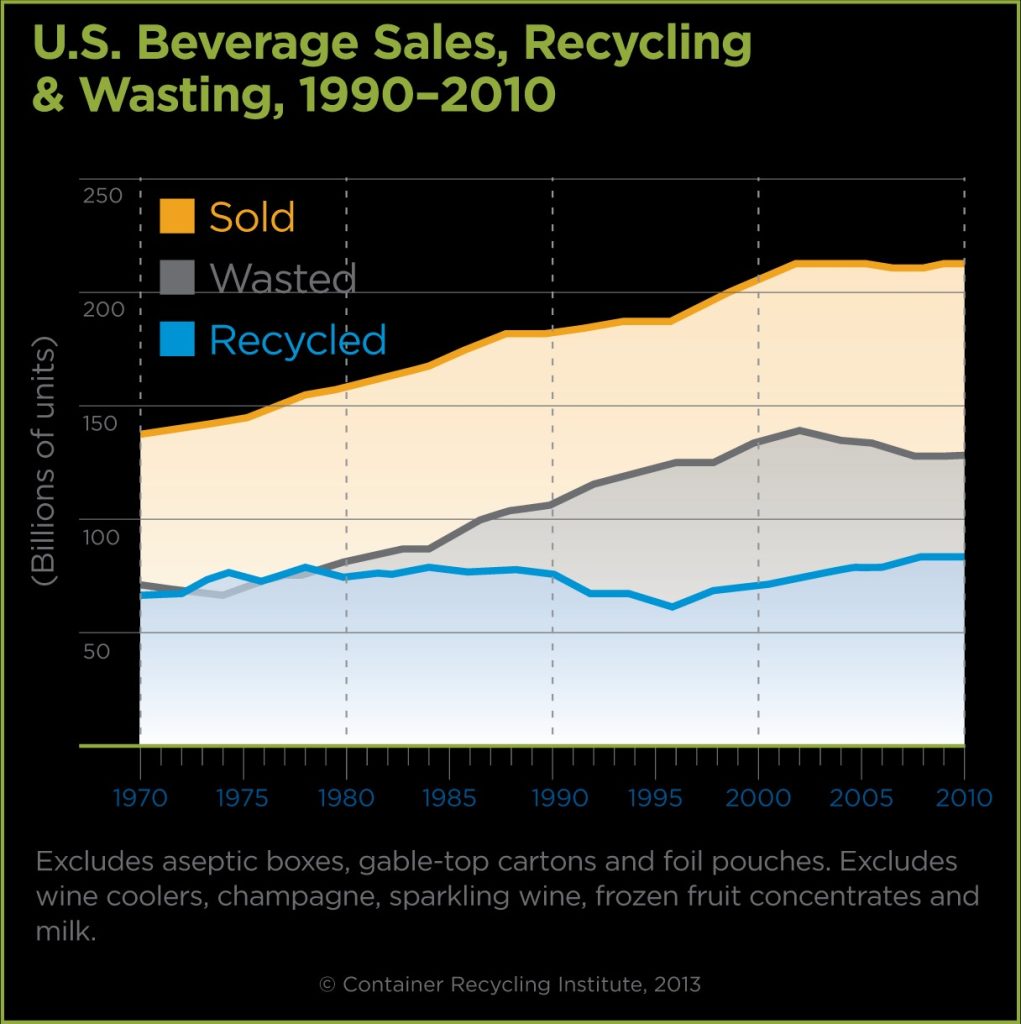
US Beverage Sales, Recycling and Wasting
CRI Supports CA AB 1149 (Coalition Letter Sign-On) – May 27, 2026
CRI supports CA AB 1149, a bill that would extend CalRecycle’s authority to pay Plastic Market Development (PMD) payments in the state through 2029 and invest funds annually for PMD payments to plastic reclaimers and product manufacturers. CRI signed onto a coalition letter with 21 other organizations in the recycling space to support this bill.
CRI Supports CA SB 955 – May 15, 2026
CRI supports California Senate Bill 955. The bill would specify that a single Reverse Vending Machine does not make an unserved convenience zone served as well as make some changes to the definition of a supermarket.
CRI Opposes Connecticut SB 457 – May 4, 2026
CRI opposes the recently amended version of CT SB 457. While CRI recognizes the issue the bill is trying to solve (which is targeting retailers that are importing beverage containers into the state without paying or initiating deposits), we believe the amended language raises serious legal and practical concerns.
CRI Supports Hawaii SB 3138, with amendments – April 15, 2026
CRI supports HI SB 3138, with amendments. This bill would change the existing auditing requirements in the state and establish a 3-tiered system of self-auditing requirements. While we support this bill, we also include some recommendations for these new requirements.
CRI Opposes Hawaii HB 1610 – April 13, 2026
CRI opposes HI HB 1610, a bill that would remove auditing and documentation requirements for all deposit beverage distributors.
CRI Opposes Connecticut SB 457, unless amended – March 12, 2026
CRI opposes CT SB 457, a bill that would create a Producer Responsibility Organization (PRO) for beverage containers in Connecticut. In this letter, CRI highlights our concerns with the bill and suggests amendments for improvement. This letter also shares solutions from other jurisdictions that Connecticut can adopt.
CRI Opposes Vermont H.915, unless amended – March 11, 2026
CRI opposes Vermont H.915, a bill that would seek to create a Producer Responsibility Organization (PRO) for beverage containers in Vermont. This bill, as written, omits several key provisions of a strong PRO, creating loopholes that could allow noncompliance and an uneven playing field for producers. In this letter, CRI highlights the issues we find […]
CRI Supports MD SB 342 – February 10, 2026
CRI supports Maryland SB 342 to establish Maryland’s beverage container recycling program.
CRI Opposes HI HB 1928 – February 4, 2026
CRI opposes HI HB 1928, a bill that would seemingly create a Producer Responsibility Organization (PRO) for beverage containers in Hawaii. In this letter, CRI highlights the issues we find with the bill, and for each issue suggests amendments.
CRI Opposes CA AB 333 – January 16, 2026
CRI opposes CA AB 333, a bill that authorizes CalRecycle to allocate up to $5 million annually for market development payments for non-container glass end-users and also creates a new definition for MRF glass products that could allow these materials to bypass beneficiation facilities.
July 9th 2025 – Updates to Beverage Container Deposit Laws in 2025
This content will be made available to the public soon.
CRI Comments on Circular CRV Association’s Dealer Cooperative Stewardship Plan – May 29, 2025
CRI appreciates the opportunity to provide comments on Circular CRV Association’s Dealer Cooperative Stewardship Plan. CRI continues to be an active participant in the stakeholder process for establishing a Dealer Cooperative in California.
CRI Supports H6206, with Suggestions May 13, 2025
CRI supports Rhode Island H6206 to establish Rhode Island’s beverage container recycling program, with suggestions.
CRI Supports RI S997, with Suggestions – May 7, 2025
CRI supports Rhode Island S997 to establish Rhode Island’s beverage container recycling program, with suggestions.
CRI Provides Neutral Comment on OR HB 3940 – April 30, 2025
This letter is written testimony on Oregon HB 3950, which would use funds from the OR bottle bill for wildfire mitigation. Our position on the bill is neutral, but this testimony highlights the importance of unclaimed deposits in funding program operations.
CRI Supports TX SB 728 – April 15, 2025
CRI supports Texas SB 728 to establish Texas’ beverage container recycling program.
CRI Supports a Previous Version of CA SB 675 – April 15, 2025
SB 675 previously concerned putting a 10% reasonable financial return into statute for processing payments that are paid to recycling centers. Now, there is an amended version of the bill that does not include this. However, CRI still believed it was important to write to the California Senate about this matter.
CRI Supports CA SB 633 – April 11, 2025
CRI supports California SB 633, which would require manufacturers to (1) report the amount of imported postconsumer recycled plastic they use by country of origin, and (2) provide proof that the PCR content they use has been validated by a third party.
CRI Supports CA SB 674 – April 11, 2025
CRI supports California SB 674, which would reduce the deposit amount for wine/spirits in bladders, boxes, and pouches <24oz from 25 cents to 10 cents.
CRI Comments on changes to CA SB 54 Regulations – May 30, 2025
CRI appreciates the opportunity to provide comments on the proposed changes to the California SB 54 regulations. CRI continues to be an active participant in the stakeholder process for establishing an EPR for Packaging in California.
CRI has serious concerns regarding discrepancies between the Governor’s 2025-2026 Budget and CalRecycle’s Year-End Financial Reports – March 18, 2025
CRI recently wrote two letters to the California Senate Budget Subcommittee No.2 and Assembly Budget Subcommittee No.4 regarding errors between the Governor’s Budget and CalRecycle’s Financial Reports, adding up to a total of over $178 million.
CRI Supports CT SB 1115 – March 17, 2025
CRI supports Connecticut SB 1115, which would prevent cross-border redemption fraud in the state. We also included clarification questions for the committee in this letter.
CRI Supports MD SB 346 – February 18, 2025
CRI supports Maryland SB 346 to establish Maryland’s beverage container recycling program.
CRI Supports MD HB 232 – February 14, 2025
CRI supports Maryland HB 232 to establish Maryland’s beverage container recycling program.
CRI Provides Comment on CA SB 156 Handling Fee Regulations – December 9th, 2024
CRI appreciates the opportunity to comment on CalRecycle’s methodology in which a handling fee rate is defined, in alignment with SB 156.
October 31st, 2024 – Improving Efficiency and Sustainability in Aluminum Beverage Can Recycling
This content will be made available to the public soon.
September 26, 2024 – Updates on California’s Beverage Container Laws and Grant Programs
MEMBERS ONLY
April 14, 2024 – Lessons Learned on International Deposit Return Systems: DRS in Germany and Lithuania
MEMBERS ONLY
December 7th, 2023 – Updates to Beverage Container Deposit Laws in 2023
MEMBERS ONLY
October 5th, 2022 – Big Changes in California’s Beverage Container Recycling Program: AB 179 and SB 1013
MEMBERS ONLY
March 16th, 2020 – Best Practices in Container Deposit Law
This content is available to the public
July 31st, 2019 – Phasing Out Plastic Pollution Through Legislation
MEMBERS ONLY
February 26th, 2019 – Duty to Warn: New Impending Crises & Price Drops and How that Impacts Recycling Programs
MEMBERS ONLY
December 13th, 2018 – Return of Refillables in the United States
MEMBERS ONLY
July 20th, 2018 – From Plastic to Progress: Bold Global Proposals from the G7, EU and UN Environment Programme
MEMBERS ONLY
June 7th, 2018 – Recovery Rates of High-Quality Recycled Glass around the World
MEMBERS ONLY
February 12th, 2018 – 2018 Container Deposit and Packaging Legislation Update
MEMBERS ONLY
November 8th, 2017 – The California Redemption Center Crisis—An Opportunity for Innovation
MEMBERS ONLY
June 14th, 2017 – Economic Impacts of the Massachusetts Bottle Bill
MEMBERS ONLY
May 5th, 2017 – Container Deposit and Packaging Legislation Update 2017
MEMBERS ONLY
April 27th, 2016 – Container Deposit and Packaging Legislation Update
MEMBERS ONLY
March 31st, 2016 – Update on the status of CalRecycle’s Beverage Container Recycling Fund in California
MEMBERS ONLY
Decmber 16th, 2015 – Contamination in Recycling
MEMBERS ONLY
October 22nd, 2015 – Community-Based Solutions for Recycling Glass
MEMBERS ONLY
September 9th, 2015 – BC Case Study: The Environmental and Economic Performance of Beverage Container Reuse and Recycling in British Columbia, Canada
MEMBERS ONLY
April 15th, 2015 – Update on the status of the CalRecycle Beverage Container Recycling Fund in California
MEMBERS ONLY
November 17th, 2014 – In-Depth look at Oregon’s Container Deposit System
MEMBERS ONLY
July 23rd, 2014 – Analysis of a Minnesota Statewide Recycling Refund Program
MEMBERS ONLY
July 16th, 2014 – Container Deposit and Packaging Legislative Update
MEMBERS ONLY
November 7th, 2013 – The Beer Store: A Model for Sustainable Packaging Management
MEMBERS ONLY
September 12, 2013 – Unveiling of the 2010 US Beverage Container Recycling Rate
MEMBERS ONLY
July 31, 2013 – Marine Debris – The Costs and Consequences
MEMBERS ONLY
July 11, 2013 – Measuring Municipal Solid Waste in the U.S.: Have We Accounted For All Of It?
MEMBERS ONLY
April 25th, 2013 – Container Deposit and Packaging Legislation Update
MEMBERS ONLY
December 14th, 2012 – Understanding EPR for Packaging – A Study of Ontario, Canada’s Blue Box Program
MEMBERS ONLY
November 1st, 2012 – Update on California’s Beverage Container Recycling Program
MEMBERS ONLY
October 4th, 2012 – Vermont’s Solid Waste Act – Big Changes Ahead
MEMBERS ONLY
September 14th, 2012 – Canada’s Beverage Container Recycling Programs – A Comparative Analysis
MEMBERS ONLY
May 24th, 2012 – Single-Stream Recycling: Is There a Better Way?
May 24th, 2012 – Single-Stream Recycling: Is There a Better Way? Download Webinar: or (right click and select “Save link as…”) Webinar Documents: PDF Single-stream comingled recycling has widely been viewed by municipalities and waste haulers as the most effective system for high volume collection of recyclables. However, the cost savings on the collection […]
May 11th, 2012 – Creating Jobs Through Recycling
May 11th, 2012 – Creating Jobs Through Recycling Download Webinar: or (right click and select “Save link as…”) Webinar Documents: PDF We all know that recycling is good for the environment, but is it also good for the economy? The Container Recycling Institute has recently released a report quantifying the net benefits of job […]