An analysis of the effects of passage of S.379 on litter, recycling, employment, and state and local financing.
Download PDF [PDF, 117KB]
An analysis of the effects of passage of S.379 on litter, recycling, employment, and state and local financing.
Download PDF [PDF, 117KB]
CRI’s analysis suggests that there may be nearly 3.7 billion units (3,690,008,614 units) for which no deposit has been paid. These “free-‐riders” in the system are worth more than $206 million in potentially uncollected CRV.
Get Download Link
CRI has undertaken a limited review of RIT’s “Impact Study of NYS Bottle Bill Expansion” (Nov. 2019), which assesses economic impacts on various stakeholders if glass liquor and wine bottles (excluding plastic and aluminum containers) were to be covered by a deposit. Download PDF [PDF, 874KB]
Over the past several years, container deposit programs have been adopted at a rapid rate in nations across the globe. What’s pushing the trend? And is it a preview of things to come in the U.S.? Download PDF [PDF, 908KB]
Summary of Findings: The operators of curbside and drop-off programs in California received $193 million in revenue from CalRecycle payments and scrap sales for CRV beverage containers in 2017. The estimated cost for handling those containers was $43 million, leading to a calculation of $150 million in gross profits, or a 349% profit. Download PDF [PDF, 449KB]
A “convenience zone” is defined as the area within a half-mile radius of a supermarket that has gross annual sales of at least $2 million. By statute, the intent is to have one redemption center in each convenience zone. This would ensure that it is just as easy to return an empty beverage container for refund as it is to purchase the beverage in the first place. Download PDF [PDF, 373KB]
House Bill 2686*, “An Act Improving Recycling in the Commonwealth” would repeal the existing beverage container deposit law (the “bottle bill”), and in its place would impose a 1-cent fee on all carbonated and non-carbonated beverages. Collected revenues would be put into a “Municipal Recycling Enhancement Fund” (the Fund), with funding to be used for recycling and litter programs. The bill sunsets this fee after three years. Download PDF [PDF, 806KB]
As all recycling professionals know, recycling isn’t a zero-cost service, even though it is often provided for “free” to households. Providing recycling for “free” is a deliberate policy decision made by municipalities to incentivize participation by residents and businesses. Download PDF [PDF, 228KB]
The Container Recycling Institute (CRI) has analyzed Iowa HF 575, successor to HSB 163.1 It would repeal the beverage container deposit law (“bottle bill”), and would impose a 1¢ “recycling program fee” on carbonated beverages. Download PDF [PDF, 684KB]
This report examines a suite of economic impacts associated with the existing Massachusetts “Bottle Bill” (originally passed as the Beverage Container Recovery Law; H.2943/S.1588).
Get Download Link [PDF, 471KB]
Addendum April 10th, 2018 – Download PDF [PDF, 32KB]
Updated Imagery included here: Download PDF [PDF, 283KB]
California needs to help restore redemption center coverage in the “recycling deserts” in the state. Here’s why. (July 2017)
Download PDF [PDF, 29KB]
Jurisdictions across North America are pondering how to handle the challenging economics of glass recovery. A beverage container recycling specialist adds to the conversation with an in-depth look at the numbers from different glass programs around the globe.
Download PDF [PDF, 5.9MB]
The American Beverage Association (ABA) recently released an “Issue Analysis” which examines the impacts of Delaware’s new Universal Recycling Law, implemented in 2011. The Container Recycling Institute (CRI) has prepared this fact sheet to provide additional information not currently presented in ABA’s analysis.
Download PDF [PDF, 602KB]
Declining scrap prices coupled with problematic compensation formulas have produced processing payment shortfalls that have already forced the closure of more than 400 redemption centers in California, posing a serious threat to the state’s beverage container recycling infrastructure and sharply constricting consumers’ ability to recover the CRV (container refund value) to which they are entitled.
Download PDF [PDF, 602KB]
Though it would require a statutory change, CRI recommends that the processing payment calculation method be reevaluated to protect the solvency of the recycling centers upon which the California beverage container recycling infrastructure depends.
Download PDF [PDF, 310KB]
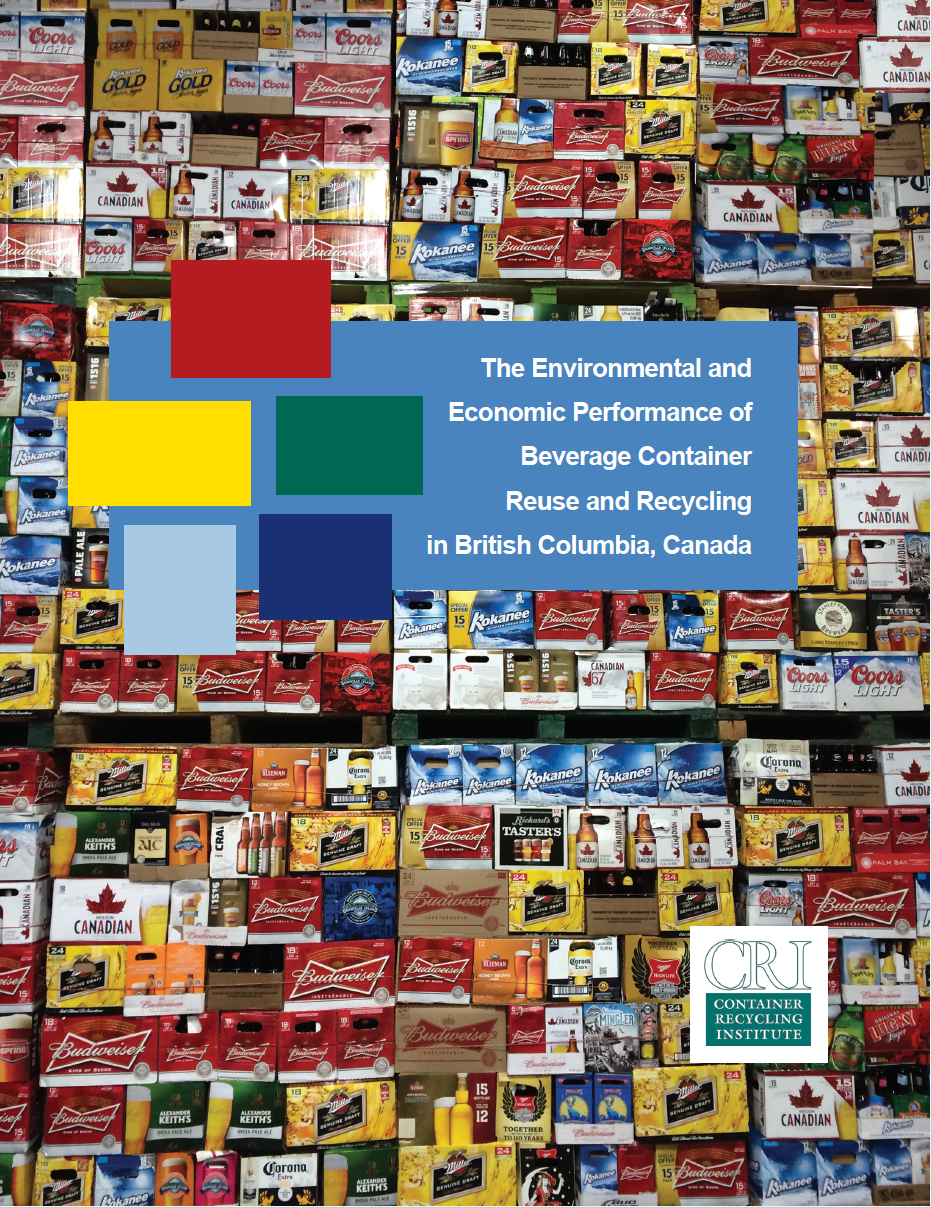
The Container Recycling Institute (CRI) undertook this case study of British Columbia’s container deposit-refund law (CDL) for two reasons: first, to expand CRI’s existing body of research on best practices for the recovery and quality recycling of packaging materials; and second, to investigate recent increases in container recycling fees (CRF) in the province, especially for glass containers. Get a Download Link
Encorp’s response letter to the BC Case Study – Download Here
Comprehensive list of Container Deposit States that do include Cider in their container deposit laws.
Download PDF
This paper looks at litter cleanup efforts and associated costs in Michigan, and attempts to determine the proportion of litter composed of discarded beverage containers.
Download PDF
Listing of Beverage Container Recycling Rates by State for Deposit Containers Only.
Download PDF
The American Beverage Association (ABA) recently released an “Issue Analysis” which examines the impacts of Delaware’s new Universal Recycling Law, implemented in 2011. The Container Recycling Institute (CRI) has prepared this fact sheet to provide additional information not currently presented in ABA’s analysis.
Download PDF
This paper compares state specific container deposit program information. Because of different reporting requirements across beverage container deposit states some information was obtained from some states, while the same information was not available from other states.
Download PDF
Long before one-way beverage bottles and cans came to dominate drink packaging in the mid-20th century,1 refillables were how Americans—and people around the world—consumed beer, soft drinks, and milk. Download PDF [PDF, 1MB]
SB 1013 would add wine and spirits containers to the Beverage Container Recycling and Litter Reduction Act, also known as a container deposit law or bottle bill.
Download PDF [PDF, 932KB]
The Container Recycling Institute (CRI) has been advocating for reform to California’s beverage container recycling program for more than a decade, and so we are delighted to see the conversation in the legislature turn toward bold proposals and acknowledgement of availability of funding for real program modernization. Download PDF [PDF, 286KB]
We are writing in support of SB1013, “An act to amend Sections 14504 and 14550 of the Public Resources Code, relating to recycling, and making an appropriation therefor…
Download PDF [364KB]
A “convenience zone” is defined as the area within a half-mile radius of a supermarket that has gross annual sales of at least $2 million. By statute, the intent is to have one redemption center in each convenience zone. This would ensure that it is just as easy to return an empty beverage container for refund as it is to purchase the beverage in the first place. Download PDF [PDF, 373KB]
CRI reviewed the per capita “nips” sales estimates in the “Connecticut Wine and Spirits Industry’s 2-Part Plan for 50 mls (Nips) and Glass Containers” and found that they differed dramatically from our BMDA derivations of “nips” sales (“2018 Beverage Market Data Analysis,” Container Recycling Institute, 2020). Download PDF [PDF, 267KB]
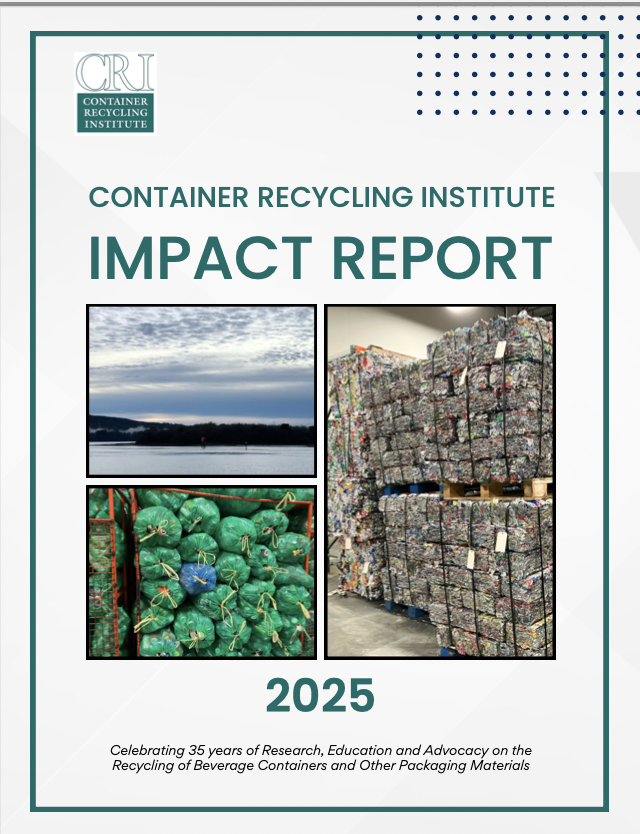
Learn how CRI made a difference in 2025 through high-profile initiatives, legislative testimony and industry presentations, and education and collaboration.