Container Recycling Institute Newsletters
Weekly Headlines from CRI – FREE
Subscribe to Weekly Headlines Newsletter
A convenient way to get news on deposit legislation around the world, plus beverage and recycling industry news, all in one place. CRI compiles articles from various news sources and sends them to your inbox once a week.
Container Recycling Institute Newsletter – Members Only
Available to CRI members only. Join CRI
CRI’s print newsletter contains current information on states, provinces and countries considering new or expanded bottle bills, as well as other current information on container and packaging recycling.
Publications
CRI Letter to US EPA on the Municipal Solid Waste Report
September 2011 | The US EPA recently invited the public to comment on its annual Municipal Solid Waste report. CRI submitted a number of suggestions, including several regarding the accounting for contamination in calculating recycling rates.
CRI Comments on “The Costs of Beverage Container Redemption in Vermont”
April 2011 | A Report by DSM Environmental Services, Inc.for the Vermont Agency of Natural Resources Solid Waste Program
CRI Comments on Natural Logic’s White Paper on EPR for Packaging
March 2011 | Natural Logic recently produced a white paper for the Coca Cola Company that summarizes an industry policy agenda for the next generation of packaging waste management stressing the principle of extended producer responsibility or “EPR.” CRI examines the paper and analyzes some flaws in its approach.
Recycling and Climate Change
CRI submitted this briefing in particular to protect the Iowa deposit law from repeal. It also serves to enhance the level of understanding of beverage container recycling in the United States and the State Iowa, and to demonstrate the impact of recycling on emissions reduction and the economy.
Why Universal Recycling in Vermont Requires Deposit Return
February 2011 Written to bolster the argument against repealing the Vermont deposit law, this briefing explains the benefits of deposit laws and the added benefits of deposit laws in conjunction with curbside recycling.
Curbside vs Beverage Fact Sheet 2012
July 2012 | Curbside Recycling Access Rates and Beverage Container Recycling
Vermont S.208 – testimony in opposition to portions of S. 208 (partial repeal of container deposit program)
CRI expresses our opposition to certain portions of Vermont S. 208, specifically those provisions which would repeal Vermont’s container deposit on liquor containers and all beverage containers greater than one liter in size.
CRI letter to CalRecycle regarding MRF performance standards
CRI’s 8/1/13 letter on the method used for the evaluation of recyclables and residuals at Mixed Waste Processing Facilities (MWPF) seeking certification as well as source-separated facilities.
CRI Comment Letter to Vermont Agency of Natural Resources
CRI’s 8/30/13 letter regarding ANR’s Draft Report Systems Analysis of the Impact of Act 148 on Solid Waste Management in Vermont
CRI Letter to State of Vermont Department of Environmental Conservation
March 2013 | CRI Commends Agency’s Report: Comparison of System Costs and Materials Recovery Rates: Implementation of Universal Single Stream Recycling With and Without Beverage Container Deposits
CRI Letter to Hawaii Legislature in Support of of SB 1133/HB 902
March 2013 | A Letter from CRI President Susan Collins to Hawaii Legislators in support of SB 1133 and HB 902 which would expand the state’s existing beverage container recycling program to include dietary supplements, including energy drinks, such as Monster and Red Bull.
CRI Letter to Hawaii Legislature in Support of HB 1062/SB 1271
March 2013 | A Letter from CRI President Susan Collins to Hawaii Legislators in support of HB 1062 and SB 1271 expanding the state’s beverage container recycling program.
A Clean and Green Vermont 2013
February 2013 | A Special Report on the Environmental and Economic Benefits of Vermont’s Bottle Bill Get
Implementing Product Stewardship in Maine 2013
January 2013 | CRI’s Review of Department’s Report to the Joint Standing Committee on Environment and Natural Resources: Implementing Product Stewardship in Maine.
Comments on Draft to Report to Minnesota Pollution Control Agency (MPCA) Recycling Refund System Cost Benefit Analysis (January 22, 2014)
The Container Recycling Institute is pleased to submit our comments on the draft report Recycling Refund System Cost Benefit Analysis, prepared by ReclaySteward Edge (RSE). Download PDF [PDF, 324KB]
Maine DEP’s February 2014 report, “Implementation of Product Stewardship in Maine”
The Container Recycling Institute (CRI) would like to commend the Department on preparing a thoughtful and comprehensive report. Maine’s impressive, and growing, list of EPR programs is a tribute to your ongoing commitment to product stewardship and responsible materials management. Download PDF [PDF, 90KB]
Support for MA Bill H.3848/Updating Massachusetts’s Beverage Container Recycling Bill (March 6, 2014)
The Container Recycling Institute writes to urge support for of Bill H.3848 to update Massachusetts’ Beverage Container Recycling Bill Download PDF [PDF, 385KB]
CRI Summary of CalRecycle’s Budget Change Proposal “Increase Beverage Container Recycling Revenue through Increased Audit Coverage”
First of three proposals, First Quarter 2014
CRI Summary of CalRecycle’s Budget Change Proposal “Beverage Container Recycling Program Reform Phase II: Sustainably Reducing the Structural Operating Deficit”
Second of three proposals, First Quarter 2014
CRI Summary of CalRecycle’s Budget Change Proposal “Initial Transition for Support of DORIIS from Contractor to State Staffing”
Third of three proposals, First Quarter 2014
CRI’s letter concerning CalRecycle’s Quarterly Report on the Status of the Beverage Container Recycling Fund (July 24th, 2014)
The Container Recycling Institute has comments and questions for the Department to help clarify understanding of the Fund’s finances. Download PDF [PDF, 138KB]
Examining the Potential for Increased Revenues in California’s Beverage Container Deposit-‐Return Program (August 13, 2014)
CRI’s analysis suggests that there may be nearly 3.7 billion units (3,690,008,614 units) for which no deposit has been paid. These “free-‐riders” in the system are worth more than $206 million in potentially uncollected CRV.
Get Download Link
Comparison of Container Deposit Programs in the United States (September 2014)
This paper compares state specific container deposit program information. Because of different reporting requirements across beverage container deposit states some information was obtained from some states, while the same information was not available from other states.
Download PDF
CRI’s review of Maine DEP’s February 2015 report, “Implementation of Product Stewardship in Maine” (January 20th, 2015)
Container Recycling Institute (CRI) would like to commend the Department on preparing a thoughtful comprehensive report. Maine’s impressive, and growing, list of EPR programs is a tribute to your ongoing commitment to product stewardship and responsible materials management.
Understanding Delaware’s Universal Recycling Law (February 2015)
The American Beverage Association (ABA) recently released an “Issue Analysis” which examines the impacts of Delaware’s new Universal Recycling Law, implemented in 2011. The Container Recycling Institute (CRI) has prepared this fact sheet to provide additional information not currently presented in ABA’s analysis.
Download PDF
CRI’s letter concerning Vermont H. 104 (March 11th, 2015)
CRI provides information related to Vermont H. 104. In particular, we’d like to correct some misstatements that were made in testimony.
Beverage Container Recycling Rate March 2015 Update
Listing of Beverage Container Recycling Rates by State for Deposit Containers Only.
Download PDF
Estimating Beverage Container Litter Quantities and Cleanup Costs in Michigan – April 2015
This paper looks at litter cleanup efforts and associated costs in Michigan, and attempts to determine the proportion of litter composed of discarded beverage containers.
Download PDF
LD 1204, “An Act To Increase Recycling and Composting by Creating the Maine Recycling Fund ” – OPPOSE; Financial Analysis LD 1204 (April 23rd, 2015)
The Container Recycling Institute opposes LD 1204, entitled, “An Act To Increase Recycling and Composting by Creating the Maine Recycling Fund.” By reducing the scope of the State’s beverage container deposit law, LD 1204 would be a step backwards for recycling.
CRI’s letter concerning Vermont H. 104 – testimony regarding H. 104 (May 2015)
The Container Recycling Institutes letter providing further information related to Vermont H. 104. In particular, to answer clarifying questions asked by committee members about the relatively high cost to collect and process PET in recycling programs as well as the documentation of cost savings to municipalities after implementation of beverage container deposit programs.
Comparative Table of Container Deposit States Inclusion of Cider in Respective Container Deposit Laws – July 2015
Comprehensive list of Container Deposit States that do include Cider in their container deposit laws.
Download PDF
BC Case Study: The Environmental and Economic Performance of Beverage Container Reuse and Recycling in British Columbia, Canada – August 2015
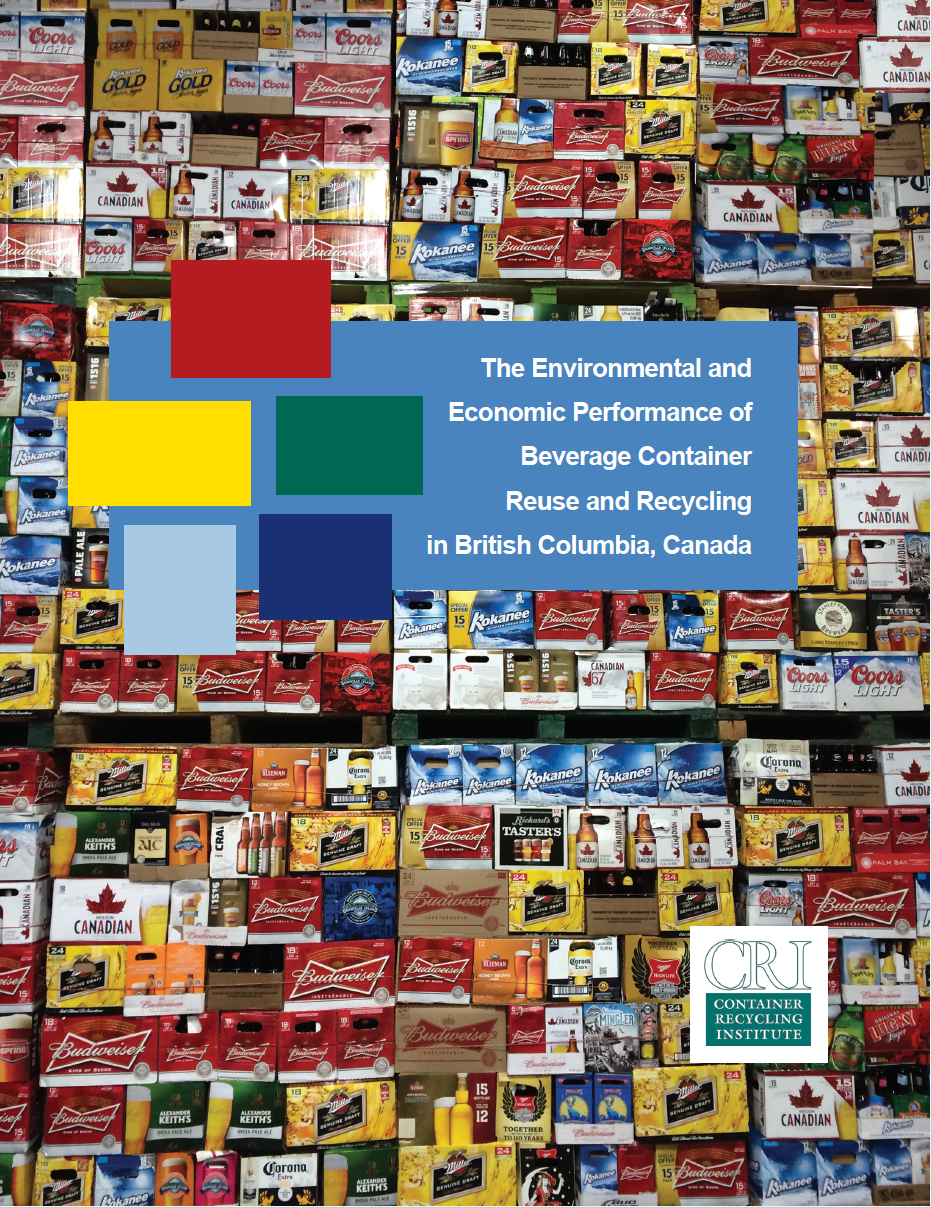
The Container Recycling Institute (CRI) undertook this case study of British Columbia’s container deposit-refund law (CDL) for two reasons: first, to expand CRI’s existing body of research on best practices for the recovery and quality recycling of packaging materials; and second, to investigate recent increases in container recycling fees (CRF) in the province, especially for glass containers. Get a Download Link
Encorp’s response letter to the BC Case Study – Download Here
Testimony of the Container Recycling Institute on “Recycler’s Perspective” for the Recycling Policy Study Committee – (October 19th, 2015)
CRI presents testimony to the Recycling Policy Study Committee concerning refundable deposits to have been shown to be an efficient and effective way to significantly increase recycling rates of beverage containers.
Revised testimony regarding CRI’s opposition to H2880 and H646 – (October 31st, 2015)
The Container Recycling Institute (CRI) opposes H646, “An Act improving recycling in the Commonwealth,” and the identically-titled bill H2880.
Testimony supporting Massachusetts H2916, “An Act to expand the bottle bill” (November 12th, 2015)
The Container Recycling Institute supports H2916, which would would add water bottles to the definition of beverage containers under the Commonwealth’s highly-‐successful beverage container deposit law (“bottle bill”), and would restore funding to the Clean Environment Fund. We will comment on both issues in this letter.
H2875: “An Act to increase recycling in the Commonwealth:” Support if Amended S1752: “An Act to increase container recycling in the Commonwealth:” Support if Amended (December 2nd, 2015)
The Container Recycling Institute (CRI) would like to register its support—if amended— of H2875 and S1752, similar bills that would conditionally expand, or update, the beverage container deposit law (or “bottle bill”) to include many non-carbonated beverages.
CRI and others Oppose MA House Bill 646 (February 23rd, 2016)
As experts in environmental protection, public health, conservation, water quality and waste reduction, we are unanimous in our opposition to House Bill 646, entitled the “Universal Recycling Law.” While that title sounds appealing, the bill does three things, all of which we reject.
Testimony supporting Maryland House Bill 862 “Maryland Redeemable Beverage Container Recycling Refund and Litter Reduction Act” (March 2nd, 2016) (March 2nd, 2016)
Container deposit programs relieve municipalities of the operational burdens and financial costs of collecting beverage containers. Lost revenue from material that is currently collected in municipal recycling programs is relatively insignificant when compared to the avoided collection and disposal costs, as well as litter cleanup and storm drain cleanout costs.
Testimony opposing Connecticut Senate Bill 312 (March 9th, 2016)
The Container Recycling Institute (CRI) opposes SB312, “An Act Requiring The Department Of Energy And Environmental Protection To Study Bottle Bill Beverage Container Refund Values And Redemption Fees.” SB312 would study the repeal the existing beverage container deposit law (the “bottle bill”), and in its place would impose a 4-cent fee on all carbonated and non-carbonated beverages, with collected revenues to be used to promote recycling and anti-littering programs in the state.
Testimony supporting Connecticut Senate Bill 384 (March 10th, 2016)
The Container Recycling Institute (CRI) supports SB384, “An Act Concerning the Application of the Bottle Bill to Wine and Liquor Bottles for Purposes of Funding State Parks.” SB384 would update Connecticut’s existing beverage container deposit law, or “bottle bill,” to include wine, sparkling wine and champagne, and liquor (spirits).
Testimony of the Container Recycling Institute on “Smart Container Act” for the Environment and Solid Waste Committee (April 1st, 2016)
Refundable deposits have been shown to be an efficient and effective way to significantly increase recycling rates of beverage containers. In the 10 states that have refundable deposits, the beverage Figure 1: Deposit States Have Higher container redemption rates average 84%.
Integrity of California’s Beverage Container Deposit System Threatened by Processing Payment Shortfalls – Report (Updated: April 2016)
Declining scrap prices coupled with problematic compensation formulas have produced processing payment shortfalls that have already forced the closure of more than 400 redemption centers in California, posing a serious threat to the state’s beverage container recycling infrastructure and sharply constricting consumers’ ability to recover the CRV (container refund value) to which they are entitled.
Download PDF [PDF, 602KB]
Processing Payment Shortfall FactSheet (Updated: April 2016)
Though it would require a statutory change, CRI recommends that the processing payment calculation method be reevaluated to protect the solvency of the recycling centers upon which the California beverage container recycling infrastructure depends.
Download PDF [PDF, 310KB]
CRI Opposes S.1865 and H.1744 – February 2017
The Container Recycling Institute (CRI) opposes the Senate bill S.1865 (Sen. Moore), “An Act improving recycling in the Commonwealth,” and the identically-titled House bill H.1744 (Rep. Garry). These bills would repeal the existing beverage container deposit law (the “bottle bill”), and in its place would impose a 1-cent fee on all carbonated and non-carbonated beverages, with collected revenues to be put into a “Municipal Recycling Enhancement Fund” (the Fund) with funding to be used for recycling and litter programs. S.1865 sunsets this fee after three years.
Cullet Comparisons – February 2017
Jurisdictions across North America are pondering how to handle the challenging economics of glass recovery. A beverage container recycling specialist adds to the conversation with an in-depth look at the numbers from different glass programs around the globe.
Download PDF [PDF, 5.9MB]
Understanding Delaware’s Universal Recycling Law (Updated: February 2017)
The American Beverage Association (ABA) recently released an “Issue Analysis” which examines the impacts of Delaware’s new Universal Recycling Law, implemented in 2011. The Container Recycling Institute (CRI) has prepared this fact sheet to provide additional information not currently presented in ABA’s analysis.
Download PDF [PDF, 602KB]
CRI Opposes Connecticut Senate Bill 996 CRI Supports House Bill 5618 – April 10th, 2017 (Updated)
The Container Recycling Institute (CRI) supports HB 5618, which would increase the beverage container handling fee that is paid to redemption centers and retailers by one cent. CRI opposes Senate Bill 996, “An Act Establishing a Bottle Recycling Fee In Lieu of a Refundable Deposit.” It would repeal the existing beverage container deposit law (the “bottle bill”), and would impose a 4-cent fee on all carbonated and most non-carbonated beverages, with revenues sent to the state’s General Fund and a new “Recycling Fee Account” to be used for various programs.
CRI supports H3528: An Act promoting the proper disposal of miniatures – June 2, 2017
The Container Recycling Institute supports H3528 (Rep. Hunt, R-Sandwich), which would add miniature bottles of 100 milliliters or less (known as “nips”) to the Commonwealth’s beverage container deposit law, or “bottle bill.” Nips are currently exempt from the 5¢ deposit.
CRI Supports Most Budget Committee Recommendations for CalRecycle (California) – June 1, 2017
The Container Recycling Institute (CRI) supports the Assembly budget committee recommendations for CalRecycle’s Beverage Container and Litter Reduction Act program. CRI supports the budget committee proposal for funding for “enhanced oversight, audit and enforcement in the beverage container recycling program.
Maine – CRI Opposses Maine LD 683
The Container Recycling Institute opposes LD 683, entitled, “An Act To Fund the Maine Solid Waste Diversion Grant Program and to Phase Out Certain Containers from the Bottle Redemption Laws.”
Winners and Losers: A Financial Analysis of Iowa’s HSB 163
A repeal of Iowa’s Bottle Bill with a new penny fee on carbonated beverages, wine, and spirits.
New Excise Tax in HSB 163 Would Only Fund Cleanup of 13% of the New Beverage Container Litter Created by Repealing the Bottle Bill
Iowa’s 5¢ deposit on beer, soft drinks, wine, and spirits is an effective incentive to refrain from littering bottles and cans or to pick up and redeem containers littered by others.
California’s Beverage Container Redemption Center Crisis: THE BIGGEST LOSERS (July, 2017)
California needs to help restore redemption center coverage in the “recycling deserts” in the state. Here’s why. (July 2017)
Download PDF [PDF, 29KB]
CRI Response to Emergency Increase in Processing Payment – October 13th, 2017
The Container Recycling Institute supports the proposed changes to the Reasonable Financial Return (RFR) described during the Workshop on Processing Payment Emergency Rulemaking. Based on our analyses that I will detail below, we believe this a good solution to the current problem.
LD 1703 “An Act To Create Equity for Wine and Spirits Container Deposits” – OPPOSE – January 2018
While we agree that the current deposit policy in Maine can be reformed for the better, this proposed legislation is not the answer. Maine, with an impressive redemption rate of 90%, is a leader in recycling – this bill would chip away at that success.
Task Force recommendations to the CT General Assembly on the CT Container Deposit Law – January 19, 2018
On behalf of the undersigned organizations, we are writing to express our collective concerns related to draft recommendations from the Task Force to Study Methods for reducing Consumer Packaging (hereafter referred to as the “Task Force”), which deal with Connecticut’s Container Deposit Law (AKA the “CT Bottle Bill”).
The Container Recycling Institute supports House Bill 5486 – February 16th, 2018 (Michigan)
The Container Recycling Institute supports House Bill 5486, which would update the Michigan deposit law to include almost all non-carbonated beverage containers.
Winners and Losers Under Iowa House File 575: An Analysis – March 2018
The Container Recycling Institute (CRI) has analyzed Iowa HF 575, successor to HSB 163.1 It would repeal the beverage container deposit law (“bottle bill”), and would impose a 1¢ “recycling program fee” on carbonated beverages. Download PDF [PDF, 684KB]
CRI Analysis of Massachusetts House Bill 2686*(repeal of Bottle Bill with penny fee on beverage containers for 3 years) – April 2018
House Bill 2686*, “An Act Improving Recycling in the Commonwealth” would repeal the existing beverage container deposit law (the “bottle bill”), and in its place would impose a 1-cent fee on all carbonated and non-carbonated beverages. Collected revenues would be put into a “Municipal Recycling Enhancement Fund” (the Fund), with funding to be used for recycling and litter programs. The bill sunsets this fee after three years. Download PDF [PDF, 806KB]
Massachusetts Container Deposit Return System: 2016 Employment and Economic Impacts in the Commonwealth (June 2017- Addendum April 2018)
This report examines a suite of economic impacts associated with the existing Massachusetts “Bottle Bill” (originally passed as the Beverage Container Recovery Law; H.2943/S.1588).
Get Download Link [PDF, 471KB]
Addendum April 10th, 2018 – Download PDF [PDF, 32KB]
Updated Imagery included here: Download PDF [PDF, 283KB]
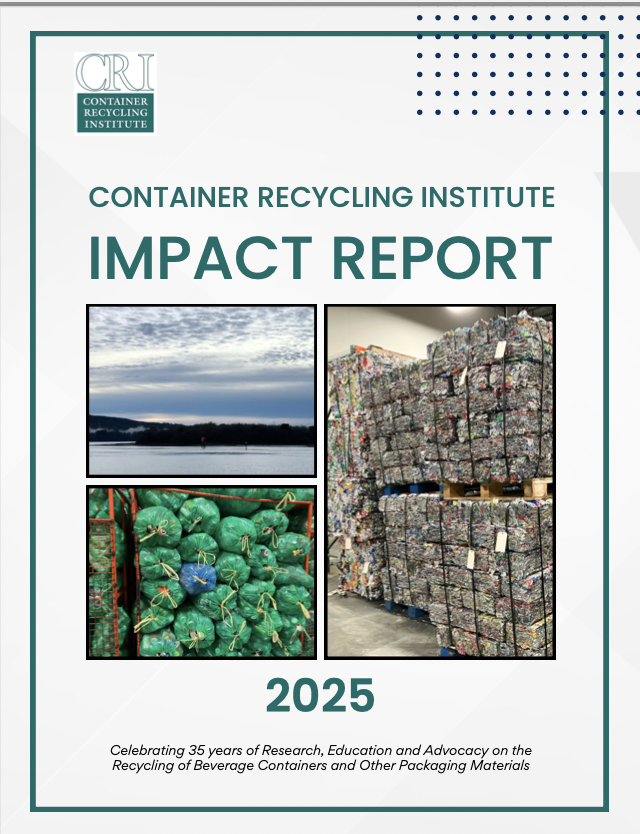
Learn how CRI made a difference in 2025 through high-profile initiatives, legislative testimony and industry presentations, and education and collaboration.